 Osaka City Guide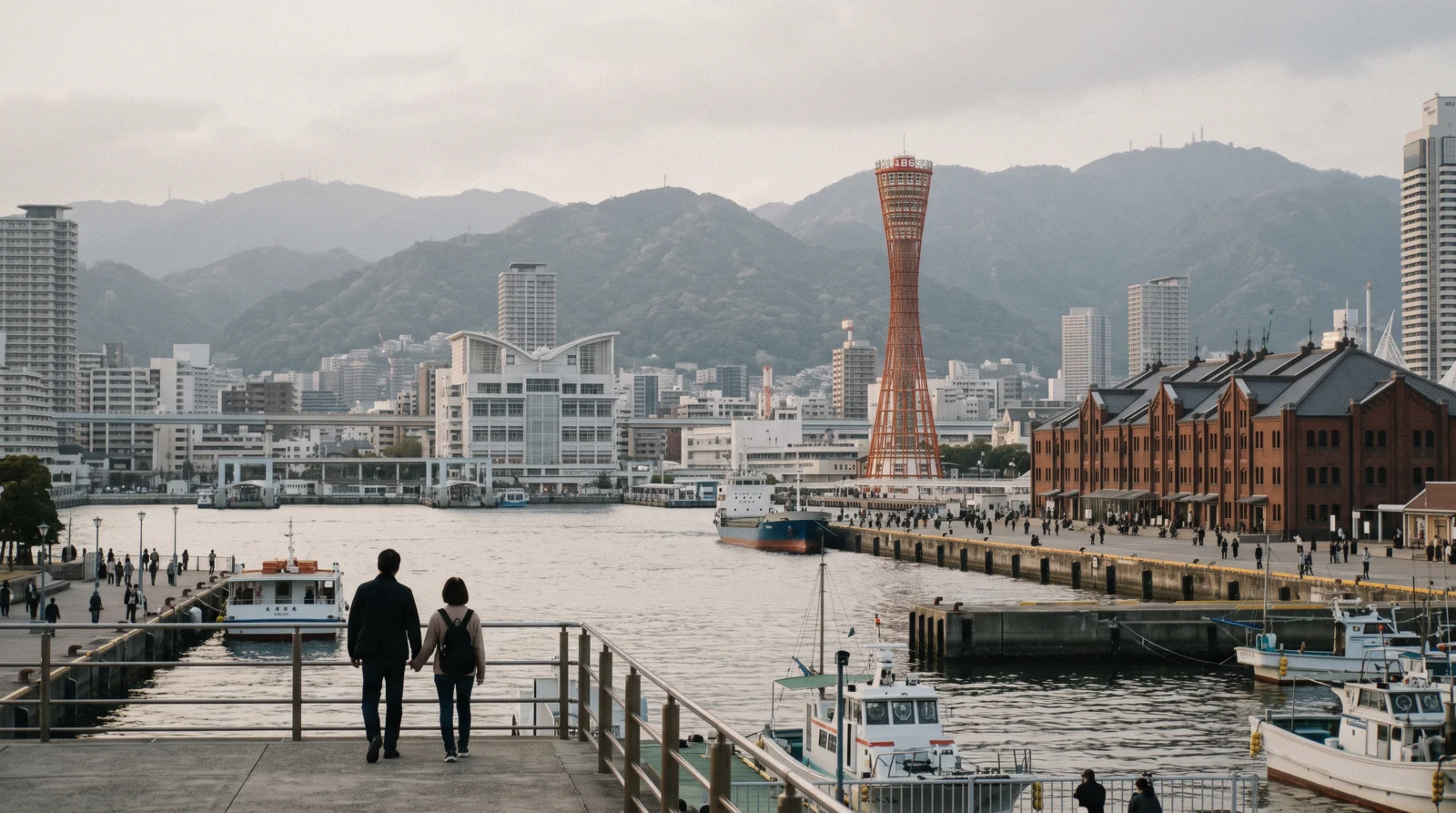
Kobe From Osaka: 21 Minutes, ¥420, and the Half Day Nobody Plans
Kobe from Osaka is the shortest day trip on this site: 30.6 kilometres from Osaka Station and the JR Special Rapid covers them in 21 minutes for $2.63 (¥420) — closer than Kyoto, closer than Nara, and the only one of the four excursions that works as an afternoon rather than a day. Two private railways do the same run for $2.07 (¥330). What makes Kobe hard to plan is not the journey but the shape of the city: a strip of flat ground between the mountains and the sea, three sights within a twenty-minute walk of each other, and then a mountain behind it with a cable car, a ropeway and a thousand-year-old hot-spring town on the far side — which is the extension every coach tour sells and most independent visitors never get to. This page prices both halves. Yen figures are the operators' own; dollar glosses are approximations at ¥1,000 ≈ $6.27 (European Central Bank reference rate via frankfurter.dev).
Quick answer The 21-minute train, the flat walking loop, and the mountain behind it
Twenty-one minutes and $2.63 (¥420) on the JR Special Rapid from Osaka Station to Sannomiya, or $2.07 (¥330) in 27 to 31 minutes on Hankyu or Hanshin from Osaka-umeda. All three are walk-on trains. The flat part of Kobe — harbour, Chinatown, the hillside villas — is a four-to-six-hour loop on foot, which makes this the one excursion from Osaka that fits into an afternoon. Fares read from JR West's My Dia engine and the Hanshin group's fare search.
Key takeaways
- JR is $0.56 (¥90) dearer and six to ten minutes quicker. Hankyu and Hanshin cost the same as each other and differ only in where they put you down — the routes table is below
- Thursday is the day to avoid. Sorakuen, the walled garden that the private Kobe day includes a ticket for, closes every Thursday, and its $1.88 (¥300) admission is the cheapest paid sight in the city
- The mountain is the real extension. Rokko's cable car is $9.72 (¥1,550) return and the through ticket to Arima Onsen — cable, mountain bus and ropeway one way — is $15.36 (¥2,450), which is what the coach tours are really selling
- Six hours is the flat city; a full day is the city plus the mountain. If you only have an afternoon, spend it between the harbour and Nankin-machi and leave Rokko for another trip
Key facts
Opening hours
| Sorakuen garden (last entry 16:30) | 09:00–17:00 |
|---|---|
| Nunobiki ropeway, spring and autumn weekdays | 09:30–17:15 last descent |
| Nunobiki ropeway, spring and autumn weekends | 09:30–21:00 last descent |
| Nunobiki Herb Gardens themselves | 10:00–17:00, or 20:30 at weekends in season |
| Rokko Cable Car, first and last departures | 07:10–21:10 |
Closed Sorakuen closes every Thursday — open if the Thursday is a public holiday, shut the following day instead — and from 29 December to 3 January, though it stays open every day through azalea season in late April and early May. Read on the garden's own information page
Admission
- Adult
- Sorakuen $1.88 (¥300); Nunobiki ropeway $15.68 return or $11.91 one way (¥2,500 / ¥1,900); Rokko Cable Car $9.72 return or $5.02 one way (¥1,550 / ¥800)
- Reduced
- Sorakuen $0.94 (¥150) for elementary and junior-high pupils; Nunobiki $7.84 (¥1,250) return for young people and school pupils, preschool children free; Rokko Cable Car $4.89 (¥780) return and $2.51 (¥400) one way for children
- Free
- Meriken Park, Harborland's waterfront and the Kitano streets cost nothing to walk; Nankin-machi charges nothing either, though it is a place you spend money by design
Planning it
- Time needed
- Four to six hours for the flat city; a full day if you add the mountain and the hot-spring town behind it
- Book ahead
- Optional — walk-up usually fine
- Address
- Kobe-Sannomiya Station, Chuo-ku, Kobe — the arrival point for all three railways from Osaka
Osaka to Kobe: three railways for two prices
Adult one-way fares for weekday midday departures, read from JR West's My Dia fare-and-time engine and Hanshin Electric Railway's own fare-and-route search, which indexes the Hankyu-Hanshin group lines, in Q3 2026.
| Route | Fare | Time | Where it leaves you |
|---|---|---|---|
| JR Osaka → Sannomiya, Special Rapid | $2.63 (¥420) | 21 min | Sannomiya, the centre — ten minutes' walk down to Nankin-machi |
| Hankyu Osaka-umeda → Kobe-sannomiya, Limited Express | $2.07 (¥330) | 27 min | The same district, a block north of the JR station and closer to Kitano |
| Hanshin Osaka-umeda → Kobe-sannomiya, Direct Limited Express | $2.07 (¥330) | 31 min | The same district again, on the seaward side of the JR tracks |
| Hankyu One-Day Pass | $8.15 (¥1,300) | Any number of journeys | All Hankyu lines except Kobe Kosoku; digital and credit-card only |
| Private guided day from Osaka | $76.71 on the platform listing | 9.5 hours | Maiko Park, Harborland, Nankin-machi, Sorakuen and Kitano — the private day |
The Hankyu figures reconcile against Hankyu's published kilometre table — 32.3 km Umeda to Sannomiya — and its fare-zone table, in which 27 to 33 km costs ¥330. The choice is smaller than it looks. Sannomiya's three stations sit within a few minutes of one another, so all three railways deliver you to the same part of town; JR buys back six to ten minutes for $0.56 (¥90), which matters on an afternoon trip and not at all on a full day. What actually decides it is where you are staying in Osaka: Hankyu and Hanshin both leave from Osaka-umeda, JR from Osaka Station next door, and from Namba you are adding a metro ride to any of them.
Kobe sells no city pass worth the name for a day-tripper, so what follows is what actually charges admission, plus the mountain tickets behind the Rokko and Arima extension. Every figure is from the operator's own page. Converted at ¥1,000 ≈ $6.27.
The city itself is free to walk, so the question is the mountain. A garden is $1.88 (¥300) and nothing else in town charges; crossing the ridge to Arima costs $15.36 (¥2,450) one way, and staying on the summit costs $14.42 (¥2,300).
| Ticket | Price | What it covers | The catch | Book |
|---|---|---|---|---|
| Sorakuen gardenA quiet hour uphill from Sannomiya — but never on a Thursday, when it shuts | $1.88 adult, $0.94 school pupils (¥300 / ¥150) | The walled Meiji-era strolling garden ten minutes uphill from Sannomiya; 09:00–17:00, last entry 16:30 | Closed every Thursday — open if it is a holiday, shut the next day instead — and 29 December to 3 January | Official site |
| Nunobiki Herb Gardens ropeway, returnAnyone starting at Shin-Kobe who wants the ride up and the terraced gardens | $15.68 adult, $7.84 young people and school pupils (¥2,500 / ¥1,250) | The cable ride up the hill behind Shin-Kobe and entry to the terraced gardens at the top | Preschool children free. The evening rate is ¥2,000 return, and there is no evening rate in summer or at Christmas | Official site |
| Rokko Cable Car, returnA straight there-and-back trip to the Rokko summit | $9.72 adult, $4.89 child (¥1,550 / ¥780) | 1.7 km and about ten minutes up to the Rokko mountain-top station at 737 m | One way is ¥800 adult, ¥400 child — buy singles if you are crossing to Arima | Official site |
| Rokko-Arima one-way ticketThe ticket for crossing the ridge and coming out at Arima Onsen | $15.36 adult, $7.71 child (¥2,450 / ¥1,230) | Cable car one way, the mountain bus across the ridge, and the ropeway down to Arima Onsen | One direction only. The obvious shape is up from Kobe and out through Arima | Official site |
| East Rokko sightseeing passA day spent on the mountain itself rather than crossing it | $14.42 adult, $7.21 child (¥2,300 / ¥1,150) | Cable car return plus unlimited mountain bus on the summit | For a day spent on the mountain itself rather than crossing it | Official site |
| Private Kobe day from OsakaVisitors from Osaka who want the whole coast handled, Sorakuen ticket included | $76.71 on the platform listing | Nine and a half hours by private vehicle: Maiko Park, Harborland, Meriken Park, Nankin-machi, Sorakuen with its ticket and the Kitano villas | Meals are not included, and the Sorakuen stop is wasted on a Thursday | Check Availability |
One price we could not source. Neither Arima Onsen's own tourism site nor the city page we could read publishes the admission for the Kin-no-yu and Gin-no-yu public baths, the two municipal bathhouses that are the reason most day-trippers cross the mountain — the portal describes the brown iron spring and the clear one and stops there. Take cash, and expect the figure to be posted at the door rather than online. The Kobe loop-bus operator's own fare page likewise returned nothing readable to us, so we print no loop-bus fare here.
Guided day trips to Kobe from Osaka
One tour in our catalogue treats Kobe as the destination rather than a lunch stop on a longer circuit, and it is a private vehicle rather than a coach — which for a city this walkable is a real distinction, since it buys you Maiko Park and the western seafront that no walking day reaches. Price and rating are the platform's own.
 from $76.71
Private Kobe Day Trip – Harbor, Chinatown & Scenic Views
Nine and a half hours in Kobe by private vehicle: Maiko Park, Harborland, Nankin-machi, Sorakuen with its ticket and the Kitano villas, with hotel pickup. Meals are on you, and the train to Kobe costs ¥330 if you would rather go alone.
Check AvailabilityPrices, ratings and details are the platform's own. Dollar figures are the listed prices. The platform bills in your account's currency.
The flat city: harbour, Chinatown and the hill of villas
Three sights, one straight line, about twenty-five minutes of walking end to end. This is the half day, and it is the excursion we point people at first among the top places to visit in Osaka.
Kobe's usable ground is a strip perhaps two kilometres deep between Mount Rokko and the sea, which is why a day here needs no transport at all once you arrive. From Sannomiya everything runs downhill to the water and uphill to the villas.
Nankin-machi, the Chinatown, is ten minutes south-west of Sannomiya: three short streets and a small square around a pavilion, packed with stalls selling pork buns and dumplings to eat standing up. It is compact — you can walk it end to end in five minutes — and it is at its best in the late afternoon when the lanterns come on and the local crowd arrives. It charges nothing and it is the cheapest lunch in the city.
Meriken Park and Harborland are another ten minutes further, on the water. The park holds the red lattice port tower and the maritime museum's white space-frame, and its most affecting corner is the preserved section of quay left buckled and tilted exactly as the 1995 earthquake left it, kept as a memorial. Harborland across the basin is a shopping and dining waterfront — good for a coffee with a view, not a sight in itself.
Kitano climbs the other way, fifteen minutes uphill from Sannomiya: the ijinkan, the Western merchants' houses built when Kobe was one of the first treaty ports opened to foreign trade. Several charge individual admissions; the streets between them cost nothing and are the better part, all steep lanes, brick and slate in a city that is otherwise entirely modern.
Sorakuen, and the Thursday that ruins a plan
Ten minutes uphill from Sannomiya, on the way to Kitano, sits Sorakuen: a walled Meiji-era strolling garden with a pond, a restored ship-owner's stable building and one of the best-kept pieces of quiet in central Kobe. Admission is $1.88 for adults and $0.94 for elementary and junior-high pupils (¥300 / ¥150), it opens 09:00 to 17:00 with last entry at 16:30, and an annual pass covering three city gardens is ¥900.
And it closes every Thursday — moving to the following day when the Thursday is a public holiday — plus 29 December to 3 January. It stays open every day through azalea season in late April and early May.
That closure is worth carrying because of what it does to a booked day: the private Kobe tour includes a Sorakuen entry ticket in its price, and on a Thursday that inclusion is worth nothing. Read on the garden's own information page.
The other paid thing on this side of town is the Nunobiki ropeway behind Shin-Kobe station: ¥2,500 return for adults and ¥1,250 for young people and school pupils, preschool children free, running from 09:30 with a last descent at 17:15 on spring and autumn weekdays and 21:00 at weekends. It lifts you over a waterfall to terraced herb gardens with the whole bay below. At ¥2,500 it is the most expensive single thing in the flat city, and it is the one to skip if the weather is grey.
The mountain extension: Rokko and Arima Onsen
What every coach tour from Osaka sells, and what it costs to do yourself.
Behind Kobe rises Mount Rokko, 931 metres of it, and on the far side sits Arima Onsen — a hot-spring town whose brown, iron-heavy kinsen water has been written about for a thousand years. Getting between them is the point: a cable car up the Kobe face, a bus along the ridge, and a ropeway down the back into the town. It is one of the better half-days in Kansai and it is why the ten-hour Himeji coach and several others pin Arima and Rokko to the end of their itineraries.
Done independently the sequence is: train to Sannomiya, city bus or Hankyu to the cable car's lower station, cable car 1.7 kilometres and about ten minutes to the summit station at 737 metres, mountain bus along the ridge, ropeway down to Arima. Departures on the cable car are clock-face: from 07:00, then at :00, :20 and :40 past each hour between 08:00 and 20:00, with a last car at 21:10.
The tickets are where the planning happens, and the through ticket is much better value than the individual legs.
| Ticket | Adult | Child | What it buys |
|---|---|---|---|
| Rokko Cable Car, one way | $5.02 (¥800) | ¥400 | Up or down the Kobe face, about 10 minutes |
| Rokko Cable Car, return | $9.72 (¥1,550) | ¥780 | Up and back, for a summit-only afternoon |
| Rokko-Arima one-way ticket | $15.36 (¥2,450) | ¥1,230 | Cable one way + mountain bus + ropeway one way — the crossing |
| East Rokko sightseeing pass | $14.42 (¥2,300) | ¥1,150 | Cable return + unlimited mountain bus on the summit |
| Rokko mountain bus, 1-day | $5.02 (¥800) | ¥400 | The ridge bus alone, for a day of summit walking |
| Rokko-Maya leisure pass | ¥3,350 Hanshin version, ¥3,500 Hankyu version | Not printed on the ticket page | Rail from Osaka plus the mountain transport; the ticket validity runs 11 April to 30 November 2026 |
What Arima does not publish
The two municipal bathhouses, Kin-no-yu for the iron-brown gold spring and Gin-no-yu for the clear silver one, are what most day visitors come for. Neither Arima Onsen's own tourism portal nor the city page we could reach publishes their admission fee, their hours or their closed days. The portal describes the two waters and stops.
We are not going to print a figure we cannot source from the operator. Take cash, look for the price at the door, and if the bath matters more than the mountain, consider Spa World in Osaka instead — its prices are published, it is fifteen minutes from Namba, and it does not need a cable car.
The honest verdict on the extension: it is a genuinely good day and it is a poor fit with the flat city. Rokko plus Arima is five to six hours on its own. Bolt it onto Nankin-machi and the harbour and you have an eleven-hour day with two hours of it on cable cars and buses. Pick one half, or take the guided version, which drives between the pieces while you sit still.
Kobe beef, and why no restaurant is named on this page
The single most searched thing about this city, and the one we refuse to attach to a shop name.
Kobe beef is a certified designation, not a style of cooking: it is Tajima-strain Japanese Black cattle raised in Hyogo prefecture and graded against published carcass standards. Restaurants that serve it display a certificate with the individual animal's identification number, and that certificate — not a sign in English on the street — is the thing to look at.
What we will not do is name a restaurant. This guide's rule is that a named eating place needs a citable list behind it — a Michelin selection, Slow Food, Gambero Rosso or the venue's own published entry — and for Kobe's steak houses we found no such list we could read and date. Every "best Kobe beef restaurant" ranking on the web is somebody's affiliate page. Ours would be no better.
What is useful, and sourceable, is the shape of the market. Lunch is dramatically cheaper than dinner at the same counter, often by half, for the same cut and the same certificate. The teppanyaki counters cluster around Sannomiya and in the streets running down towards Nankin-machi. And the certificate is worth asking to see: the phrase is Kobe-niku no shomeisho, and a restaurant serving the real thing will produce it without being embarrassed.
If the beef is the reason for the trip, note that it removes the argument for an afternoon visit — lunch service is when the price gap is in your favour, which means a morning train and a table booked before you leave Osaka.
How long Kobe wants, and what it costs
The only excursion from Osaka that genuinely works in half a day, priced both ways.
Four to six hours covers the flat city properly: Sannomiya, Kitano's lanes, Sorakuen, down through the centre to Nankin-machi for something eaten standing up, and out to Meriken Park for the harbour and the earthquake memorial. That is perhaps four kilometres of walking on flat ground, no transport needed after the train.
A full day adds either the mountain crossing to Arima or a leisurely lunch at a beef counter. It does not comfortably add both.
An afternoon — a 14:00 train from Osaka — buys Nankin-machi and the harbour at their best hour, with the lanterns and the light on the water, and gets you back for a late Osaka dinner. That is a real option here and it is not one at Kyoto or Himeji.
| Item | Per person | Source |
|---|---|---|
| Hankyu or Hanshin return, Osaka-umeda ⇄ Kobe-sannomiya | $4.14 (¥660) | Hanshin group fare search |
| JR return, Osaka ⇄ Sannomiya | $5.27 (¥840) | JR West My Dia |
| Sorakuen | $1.88 (¥300) | sorakuen.com information page |
| Nunobiki ropeway return, if you take it | $15.68 (¥2,500) | kobeherb.com fares page |
| Rokko-Arima crossing, if you take it | $15.36 (¥2,450) | rokkosan.com ticket page |
| Flat-city day, transport and one garden | About $6.27–$7.52 (¥1,000–¥1,200) | Sum of the sourced rows above |
Against the guided day
A do-it-yourself flat-city day costs around ¥1,000 a head in transport and admissions — the cheapest excursion in this guide by a distance, since the walking is free and Nankin-machi is street food. The private guided day is $76.71 and runs nine and a half hours.
So what is the $76 buying? Three things a walking day cannot get: Maiko Park and the western seafront under the Akashi Strait bridge, which is a bus ride out of the centre and rarely reached on foot; the Sorakuen ticket included in the price; and a vehicle that carries you between the harbour, Chinatown, the garden and Kitano rather than making you walk the loop. It is rated 4.9 from 26 reviews, it is listed as wheelchair accessible and it can collect you from an Osaka hotel.
Our verdict: if you are two able walkers with an afternoon, take the ¥330 train and walk. If you are a family, a group of four, or anyone for whom four kilometres of city walking is the difference between a good day and a bad one, the private car is doing real work — and on a Thursday, ask them to swap the garden for something open.
Kobe from Osaka: the walking loop and the mountain behind it
Everything in blue is within twenty-five minutes' walk of the station; everything in gold needs the cable car and the ridge bus. Coordinates are Wikidata's.
The vertical gap on this map is the planning point. The four blue pins are one walk; the two gold ones are a separate half-day involving a cable car, a ridge bus and a ropeway. Trying to join them in a day from Osaka makes for eleven hours, two of them in transit.
What pairs with a Kobe day, and what it competes with
Kobe is on the same westbound railway as the biggest castle in Japan, which makes the choice between them a real one.
Himeji Castle from Osaka
The same JR Special Rapid carries on to Himeji for ¥1,460. Several coach tours pair the two in one day — worth reading the castle's own queueing warning before you agree to that.
40 minutes further westDay trips from Osaka
Where Kobe's 21 minutes sit against Kyoto, Nara, Himeji, Minoh and Koyasan, with the fare and the honest time each one wants.
All six, comparedSpa World
If the hot spring rather than the mountain is what draws you to Arima, this is the Osaka version — published prices, fifteen minutes from Namba.
In Osaka, no cable car requiredKobe from Osaka: questions
How long is the train from Osaka to Kobe?
Twenty-one minutes on the JR Special Rapid from Osaka Station to Sannomiya, over 30.6 kilometres, for $2.63 (¥420). Hankyu's Limited Express from Osaka-umeda takes 27 minutes and Hanshin's Direct Limited Express 31, both for $2.07 (¥330). None of the three needs a reservation or a supplement. Times and fares read from JR West's My Dia engine and the Hanshin group's fare search.
Is Kobe worth a day trip from Osaka?
Worth an afternoon, certainly — and that is the distinction that matters. The flat city is a four-to-six-hour walking loop: Kitano's merchant villas, the ¥300 garden at Sorakuen, Nankin-machi's three streets of street food and the harbour with its earthquake memorial. It is the only excursion from Osaka that works on a 14:00 train. It becomes a full day only if you add the mountain crossing to Arima Onsen or a proper beef lunch.
What is the cheapest way to get from Osaka to Kobe?
Hankyu or Hanshin from Osaka-umeda at $2.07 (¥330) each way — the same price on both, differing only by four minutes and by which side of the tracks they leave you. JR at ¥420 buys back six to ten minutes. For a return trip that is a gap of $1.13 (¥180), so take whichever leaves from the station nearer your hotel; the routes table sets out all three.
Can you visit Arima Onsen and Mount Rokko on a day trip from Osaka?
Yes, but as the whole day rather than as an addition. The crossing is a cable car up the Kobe face (¥800 one way), a bus along the ridge and a ropeway down to Arima, sold together as a one-way ticket for $15.36 (¥2,450), and it takes five to six hours with stops. Note that neither Arima's own tourism site nor the city page we could read publishes the admission for the Kin-no-yu and Gin-no-yu public baths — take cash.
What is there to do in Kobe in one day from Osaka?
The sequence we would walk: Sannomiya to Kitano for the villa lanes, back down to Sorakuen for ¥300, through the centre to Nankin-machi for pork buns eaten standing up, then out to Meriken Park for the port tower and the preserved earthquake quay, finishing at Harborland as the light goes. About four kilometres, no transport needed, and roughly ¥1,000 a head all in including the train.
Which day should you not go to Kobe?
Thursday, if Sorakuen is on your list — the garden closes every Thursday, moving to the Friday when the Thursday is a public holiday, and it also shuts from 29 December to 3 January. That matters more than it sounds, because the private guided day includes a Sorakuen ticket in its price. Weekends are busier at the harbour but nothing closes.
Do you need a pass for a Kobe day trip?
No. A return on the private railways is $4.14 (¥660) and there is nothing else to ride, since the flat city is walked. The Hankyu One-Day Pass at ¥1,300 and the Hankyu-Hanshin One-Day Pass at ¥1,600 only pay off across a day with several journeys on those networks. If the mountain is in the plan, the ¥2,450 Rokko-Arima through ticket is the one to buy, and it is bought up there rather than in Osaka.
Where Kobe fits in an Osaka trip
The excursion to keep in reserve, because it is the only one that fits a gap.
Because it is 21 minutes away and needs no ticket bought in advance, Kobe is the trip to hold back rather than schedule. A morning that ends early, a day when the weather turns and the indoor plan collapses, an afternoon left over after a short Nara morning — that is when a ¥330 train and a harbour walk earn their place.
It is also the sensible answer to a specific mistake. Visitors with three Kansai days often plan Kyoto on one, Nara on another and Himeji on the third, and arrive home having spent nine hours on trains and none in Osaka itself. Swapping one of those for a Kobe afternoon gives back most of a day, and the choice of where to stay in Osaka first time makes the case for keeping some of these days in the city where the food is.
If you do give Kobe a full day, give it the mountain rather than more of the flat city — the ridge, the ropeway and the hot-spring town are a different sort of day from anything Osaka offers, and the flat city can always be an afternoon later in the trip. The day-trips hub sets that choice against the other five.
Kobe on film: the day and the mountain
Three films we checked ourselves — each id verified against YouTube's own record and its thumbnail, so none is a dead player. Between them they cover the itinerary from Osaka, a full day in the flat city, and what the place is beyond the beef.
Kobe Day Trip Itinerary from Osaka or Kyoto
The routing this page describes, filmed as a day out and back.
Video: Trip MoitoKobe In A Day — Top Things to Do, See & Eat in Kobe, Japan
A full day in the flat city, useful for judging how much walking the loop really is.
Video: Jay and KarolinaTHE Kobe Guide: Much MORE Than Kobe Beef
The case for the harbour, Kitano and the mountain rather than the steak counter.
Video: PiQtour JapanVideos load from YouTube only when you press play.
Prices, hours and terms are set by the venue or operator and confirmed at checkout.
We may earn a commission if you book through one of our links, at no extra cost to you. Full affiliate disclosure