 Osaka City Guide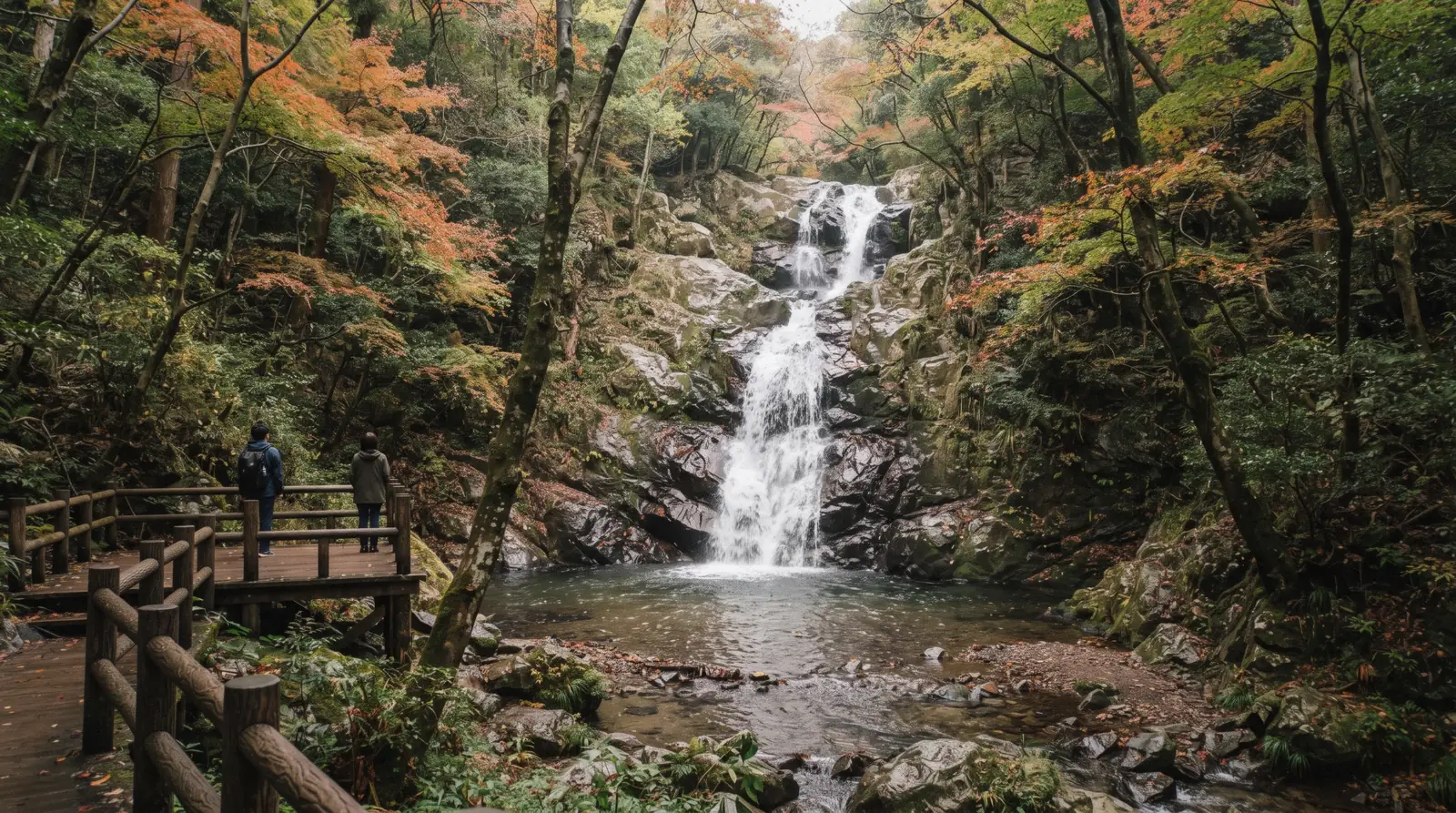
Minoo Falls
Minoo Falls is the cheapest real day trip out of Osaka and the only one that asks nothing at a gate. A train from Umeda, a walk of about 2.7 kilometres up a paved river gorge, and a 33-metre waterfall at the end of it — no ticket, no timed slot, no counter to queue at. The park publishes the distance and the walking time; the prefecture publishes the park's status and its facilities; nobody publishes an admission fee, because there is none to publish. This page prints those figures with the pages they came from, adds the fares from Osaka, and covers the one thing on this trip that does cost money: Katsuo-ji, the daruma temple in the hills above the gorge, which is a separate journey with a separate donation. For the rest of the city's sights, see things to do in Osaka, and the other escapes on the day trips hub.
Quick answer No fee, ¥280 from Umeda, 2.7 km each way, 33 metres of waterfall
Minoo Falls costs nothing to see. Osaka Prefecture's own facility record for the park carries no admission field, the park's site publishes no fee, and the prefecture marks every facility in the Meiji-no-Mori Minoh Quasi-National Park — visitor centre, exhibition room, car parks, cooking hut — as free. The waterfall is 33 metres high and sits about 2.7 kilometres up the Takimichi trail from Hankyu Minoo station, which the park's own page times at 40 to 50 minutes on foot. Getting there from Osaka-umeda costs $1.76 (¥280) one way on the Hankyu Takarazuka and Minoo lines, with one change at Ishibashi-handai. Fares come from the park's and the prefecture's own pages, and yen figures on this page convert at ¥1,000 to about $6.27, the European Central Bank reference rate.
Key takeaways
- $3.51 (¥560) return and a pair of shoes is the whole compulsory budget — the fare and time table sets the trip beside Kyoto, Nara and Kobe, which all cost more
- The only money anyone takes from you up here is at Katsuo-ji, the daruma temple above the gorge: $3.14 (¥500) at the gate, and the QR-code admission ticket sells the same entry at $10 — convenience, not a saving
- The trail is paved the whole way and the park lends an electric-assist wheelchair; it also bans drones, fires and feeding the monkeys, and none of those rules are posted in English at the station
- One long guided day does exist — the Katsuo-ji, Kobe and Arima coach trip — but it skips the waterfall entirely; see what it actually visits before you book it
Key facts
Opening hours
| Minoh Park and the Takimichi trail | Open–No closing time published |
|---|---|
| Katsuo-ji, weekdays and Sundays/holidays | 08:00–17:00 |
| Katsuo-ji, Saturdays | 08:00–18:00 |
| Park management office (telephone) | 09:30–17:00 |
Closed None published for the park. Katsuo-ji publishes no closed day either; its reception shuts 30 minutes before closing. The prefecture's own visitor facilities in the quasi-national park close on Tuesdays (the following day when Tuesday is a holiday)
Admission
- Adult
- No admission fee published for the park or the falls; Katsuo-ji asks $3.14 (¥500) from high-school age up
- Reduced
- Katsuo-ji: $2.51 (¥400) elementary and junior-high, $0.63 (¥100) preschool
- Free
- The waterfall, the trail and every prefectural facility in the quasi-national park; Katsuo-ji is free under the age of two
Planning it
- Time needed
- Not stated by the park; its own access page gives 40–50 minutes each way on foot, so allow three hours from Umeda and back, four with a stop for tea
- Address
- Minoh Park, Minoh 1-chome, Minoh City, Osaka Prefecture (park management office 072-721-3014, 09:30–17:00)
There is no ticket for Minoo Falls, and that is the useful fact rather than a gap. What follows is every place on this trip that does take money, priced from the operators' own pages in Q3 2026, with the two GetYourGuide options for Katsuo-ji set beside the temple's own gate price.
The falls and the trail take no money at all, so the only question is Katsuo-ji: $3.14 (¥500) at its gate, or $10 for the same admission as a QR code. The minivan day at $75.35 is buying transport, not entry.
| Option | What it costs | What it covers | Book | Book |
|---|---|---|---|---|
| Minoh Park and the waterfall — walk inEveryone — no admission fee is published for the park or the falls | No admission fee published | The Takimichi trail, the falls, the viewing area, the prefectural facilities in the quasi-national park | Nothing to book | Official site |
| Katsuo-ji entrance donation, paid at the gateAnyone walking up to the temple; the cheapest way through its gate | $3.14 adult, $2.51 school age, $0.63 preschool (¥500 · ¥400 · ¥100) | The temple grounds, the daruma slopes, the pond and the hall; reception shuts 30 minutes before closing | Pay on arrival | Official site |
| Katsuo-ji admission with QR-code entryOnly if a cancellable booking in hand is worth more than the gate price | $10 | The same admission, scanned at the gate instead of paid there; no transport included | Free cancellation up to 24 hours before | Check Availability |
| Katsuo-ji, Kobe-Sanda outlets and Arima Onsen by minivan, 10 hoursA car-free day that pairs the temple with the outlets and Arima Onsen | $75.35 | Katsuo-ji admission and transport for nine passengers; no waterfall, no lunch, no bathing fee | Free cancellation up to 24 hours before | Check Availability |
The official rows carry plain links and no tracking, so the platform's mark-up on the Katsuo-ji admission is visible rather than implied. Official prices come from mino-park.jp and katsuo-ji-temple.or.jp, and platform prices are GetYourGuide's listed USD.
What the day costs and how long each leg takes
Every figure below comes from an operator's or an authority's own page. Nothing here is estimated except where the row says so.
| Leg | Time | Cost | Booking |
|---|---|---|---|
| Hankyu Osaka-umeda → Minoo, Takarazuka Line express then Minoo Line local, one change at Ishibashi-handai | 26 minutes | $1.76 (¥280) each way | None — tap in with an IC card |
| Minoo station → Ichinohashi, the park entrance | About 5 minutes on foot | Free | None |
| Ichinohashi → Minoo Falls on the Takimichi trail, about 2.7 km | 40–50 minutes on foot, the park's own figure | Free | None |
| Katsuo-ji, reached by Hankyu bus from Minoh-Kayano station or by taxi (about 20 minutes from Minoo station) | About 20 minutes by taxi; bus fares are not published on any page we could read | $3.14 (¥500) at the gate | None; the QR ticket is $10 |
| The whole compulsory day: Umeda to the falls and back | About 3 hours door to door | $3.51 (¥560) | None |
The rail fare comes from the Hanshin group's fare-and-route search, which indexes the Hankyu-Hanshin lines, cross-checked against Hankyu's published fare-zone table; the distance and walking time from mino-park.jp; the donation from katsuo-ji-temple.or.jp. All come from those sources.
The two bookable options that touch this trip
Neither of these is a tour of the waterfall — no operator on this site sells one, because there is nothing to sell entry to. Both are Katsuo-ji products, and the cards below print what each includes so the difference is visible before checkout. Prices are GetYourGuide's listed USD.
 from $10
Osaka: Katsuo-ji Temple Ticket with QR Code Entry
A QR-code admission ticket for the daruma temple in the Minoo hills and nothing else — no transport, and Katsuo-ji has no station of its own. The gate sells the same ticket, so this buys a smoother entry rather than a saving.
Check Availability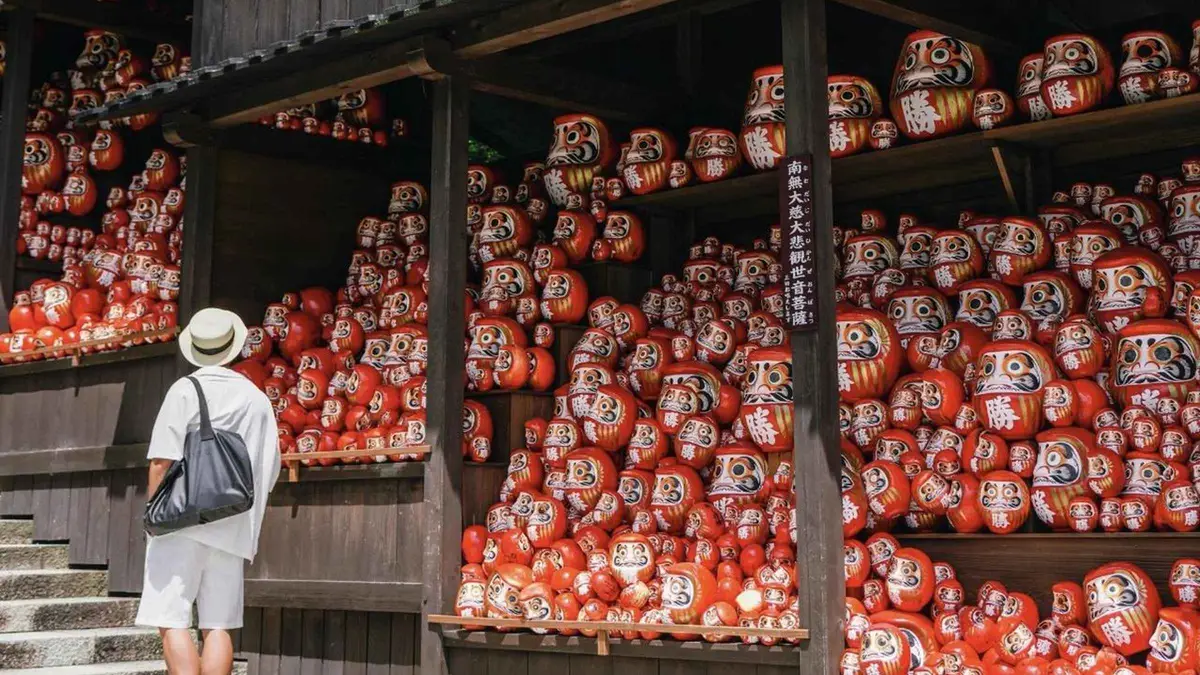 from $75.35
From Osaka: Katsuo-ji Temple, Kobe, & Arima Onsen Day Trip
Ten hours in a nine-seat van: the daruma-covered Katsuo-ji with its ticket, two hours at the Kobe-Sanda outlets, then Arima Onsen and the port. A fifth of the day is shopping, the onsen bathing fee is extra and only three people have rated it.
Check AvailabilityPrices, ratings and details are the platform's own. Dollar figures are the listed prices. The platform bills in your account's currency.
What Minoo Falls Actually Is
The waterfall is a single 33-metre drop at the head of a wooded gorge in the northern hills of Minoh City, about 20 kilometres from central Osaka. The park's own page gives the height as 33 metres and records the fall's place on the list of Japan's hundred notable waterfalls; the Osaka tourism bureau's English entry adds a width of about five metres. The name is the useful piece of local etymology: the sheet of water was thought to resemble a 箕 (mi), the winnowing basket a farmer shakes grain in, and the city and the river took their name from the waterfall rather than the other way round.
The falls sit inside the prefectural Minoh Park — 83.8 hectares of river gorge — which in turn sits inside the Meiji-no-Mori Minoh Quasi-National Park. The prefecture's page on that designation is worth a paragraph because it explains why a place this close to a city of two and a half million still looks like forest: the area was designated in 1967, in the centenary year of the Meiji restoration, at the same time and for the same reason as Mount Takao on the western edge of Tokyo. The protected area runs to 963 hectares of low mountain between 100 and 600 metres, and the prefecture counts roughly 1,100 plant species and 3,000 insect species inside it.
Why it is on this site at all
Because it answers a question the rest of the guide cannot. Osaka's paid attractions are indoors, ticketed and, in the case of Universal Studios Japan and the aquarium, expensive and timed. Minoo is the opposite of all four things: outdoors, free, unbooked and 26 minutes from Umeda.
On a wet week it is the reason to keep an afternoon loose, and in the second half of November it is the busiest thing in the prefecture that nobody sells a ticket for.
The Walk: 2.7 Kilometres of Paved River Path
The route has one name and no branches that matter: the Takimichi, the waterfall road, which starts a five-minute walk from the station ticket gates and follows the Minoh river upstream to the fall.
The park's own access page times the walk from Hankyu Minoo station to the entrance at Ichinohashi at about five minutes, and from there to the waterfall at 40 to 50 minutes; its Q&A gives the distance as about 2.7 kilometres. That is a 90-minute round trip of walking before you stop for anything, and the gradient is gentle and continuous rather than stepped — this is a paved road closed to traffic, not a mountain path. General vehicles, motorcycles and bicycles are all barred inside the park, which is why the surface stays comfortable and why there is nowhere to park at the top.
Two consequences follow from that and both catch people out. The first is that there is no parking in the park or along the trail: the paid car parks are down by the station and there is an upper car park on prefectural route 43 above the falls, which is a different journey entirely. The second is that the walk is the attraction.
Half of what people photograph on this trip — the river, the gorge, the tea houses, the insect museum, the small temple at Ryuanji — happens between the station and the fall, and a visitor who takes a taxi to the top of the road has skipped the day rather than saved time.
| Point on the walk | From the station | What is there |
|---|---|---|
| Hankyu Minoo station | 0 minutes | Ticket gates, the tourist information office, the last convenience store |
| Ichinohashi, the park entrance | About 5 minutes | The bridge where the Takimichi begins and the road turns to river |
| The tea-house stretch | 10–25 minutes | Shops selling momiji tempura, benches, the insect museum turning |
| Minoo Falls | 40–50 minutes | The 33-metre fall, the viewing area and the bench area in front of it |
Getting up there without walking it
The trail is paved and gentle enough that the park announced an electric-assist wheelchair loan on 7 August 2026, which tells you more about the surface than any blog description. There is no shuttle up the Takimichi — nothing motorised is allowed on it — so the alternatives are a taxi round to the upper car park on the prefectural road, or simply turning back early: the gorge is at its best in the first kilometre anyway.
Getting There From Osaka
One line does the whole job, and the change is the only thing to remember.
From Hankyu Osaka-umeda, take a Takarazuka Line express 15 minutes to Ishibashi-handai, cross to the Minoo Line and ride six minutes to the terminus at Minoo. Twenty-six minutes and $1.76 (¥280), taken from the Hanshin group's fare-and-route search, which indexes the Hankyu lines. The station romanises as Minoo on Hankyu's own signage and as Minoh on the city's; the waterfall answers to both, and this page uses whichever spelling the source used.
From Namba or the southern half of the city, ride the Midosuji Line north to Umeda and change to Hankyu — the getting around page covers the metro fare bands. There is a second route north: the Midosuji Line now runs beyond Senri-Chuo to Minoh-Kayano, and Hankyu buses (routes 21 and 36) connect Minoh-Kayano with Hankyu Minoo station. The Osaka tourism bureau's own entry gives the same option as a Hankyu bus from Senri-Chuo.
Neither operator publishes those bus fares on a page our fetch could read, so this page does not print a figure for them; the ¥280 Hankyu ride is the one route with a verified fare and it is also the cheapest.
The trip that goes to Katsuo-ji instead
Katsuo-ji is not on the Takimichi. It sits about four kilometres north-east of the falls as the crow flies, up a mountain road, and the temple's own access page routes visitors by direct Hankyu bus from Minoh-Kayano station, running to a fixed timetable through the middle of the day and supplemented by extra departures every five to ten minutes when the crowds justify them. By taxi the temple gives about 15 minutes from Minoh-Kayano, about 20 minutes from Hankyu Minoo and about 12 minutes from Saito-nishi on the Osaka Monorail.
Combining the two on foot is a hike rather than a stroll, and the honest advice is to pick one of them for a half day or give the pair a full one.
What Actually Costs Money Up Here
Three things, and only one of them is compulsory.
The train is the compulsory one: $3.51 (¥560) return from Umeda. After that the park takes nothing. Osaka Prefecture's facility record for Minoh Park carries no fee field at all and lists the park as open around the clock with no closing days; the prefecture's facility guide to the quasi-national park marks the visitor centre, the exhibition room, the car parks and the cooking hut as free, with reservations required only for the cooking hut, which runs April to November, 09:30–15:00.
The Osaka tourism bureau's English page states it plainly as “free admission”.
The second is Katsuo-ji, which is a genuine ticket: $3.14 (¥500) from high-school age, $2.51 (¥400) for elementary and junior-high pupils, $0.63 (¥100) for preschoolers and free under two. The temple calls it an entrance donation rather than an admission, but it is collected at the gate like a fare. Parking there is ¥1,000 for two hours for a car, with a reservation required at weekends and on holidays — a figure worth knowing if a hire car is on the table, because it is roughly twice the return train fare.
The third is the food, and it is the pleasant one. The stretch of the Takimichi between the entrance and the falls is lined with tea houses and shops selling momiji tempura — maple leaves salted, battered and fried one at a time into a sweet, brittle crisp. Minoh City lists it among the things that exist nowhere else, and it is genuinely local rather than a tourist invention.
This site does not name shops on the trail: no citable list covers them, and the ones that look busiest change with the season. Buy the bag from whichever place has a queue of Japanese day-trippers in front of it.
Katsuo-ji, the Daruma Temple Above the Gorge
The other half of the Minoo hills, and the reason the two GetYourGuide products on this page exist.
Katsuo-ji is the twenty-third temple of the Saigoku pilgrimage and, in the internet age, the daruma temple: thousands of small round red dolls left in every crevice of the grounds by people whose wish came off. The temple trades on 勝運, luck in winning, which is why the dolls arrive by the coachload before exams and matches. Its hours are 08:00 to 17:00 on weekdays and on Sundays and public holidays, with reception closing at 16:30, and 08:00 to 18:00 on Saturdays with reception until 17:30 — the Saturday extension is the one detail most third-party pages omit.
The GetYourGuide QR-code ticket at $10 is the same admission you can buy at the gate for ¥500, so the calculation is simple: at ¥1,000 to about $6.27 the gate price is about $3.15, and the platform version costs the difference for a scannable entry and a 24-hour cancellation window. It includes no transport, and the temple has no station of its own. Book it if a group is arriving together and you want the entry settled in advance; otherwise carry coins.
The ten-hour minivan trip is a different proposition entirely — Katsuo-ji, then the Kobe-Sanda outlet mall, then Arima Onsen and the port, with the bathing fee and lunch extra and only three ratings on the listing. It never goes near the waterfall. The minivan listing shows how thin the options are for this corner of the hills, so it is worth comparing the best tours in Osaka before committing to a day out here.
Doing both in one day
It works if you start early and treat the bus timetable as the constraint. Ride to Minoo, walk the trail and be back at the station by lunchtime, then take a taxi or ride via Minoh-Kayano to the temple for the quieter afternoon hours. The reverse order also works and is better in autumn, when the trail fills after lunch.
What does not work is planning to hike between the two on the ridge paths in the short daylight of November and December: the connection exists, but it is a mountain walk of several hours and no part of it is lit.
The Rules Nobody Posts in English
All four of these come off the park's own Q&A, and all four are broken daily by visitors who never saw them.
- Drones and radio-controlled aircraft are banned across the entire park, the waterfall and its plaza included — not restricted, banned.
- No fires of any kind, barbecues included, anywhere in the park. The only cooking allowed is at the prefecture's reservable cooking hut, which is a separate facility with its own season and hours.
- Dogs are welcome on a lead; the park states there is no dog run, and the lead is not optional on a trail this narrow at its busiest.
- Feeding the monkeys is prohibited by Minoh City ordinance. The wild macaques along the gorge are the reason: they associate bags with food, and an open rucksack on a bench is an invitation.
Two more practical points that follow from the terrain. The Minoh river runs high after heavy rain and the park closes the bench area in front of the falls when it does — it did exactly that in August 2026 and posted the reopening on 28 August. And the trail is a river gorge with no shortcut back: whatever the weather does while you are at the top, you are walking the same 2.7 kilometres to get out of it.
What the Park Is Saying Right Now
The park keeps a dated notice board on its own site, and on a trip with no ticket and no booking it is the only status page that matters. This is what stood on it.
The most important entry is dated 7 August 2026: the closure was lifted and the whole length of the Takimichi is walkable to the falls again, after disaster-recovery work that the park recorded as finished on 17 July 2026. A trail this exposed to storm damage closes in sections more often than visitors expect, and a blogger’s account from last year is not a reliable answer for this one. The same date carries the electric-assist wheelchair loan notice.
| Dated | Notice |
|---|---|
| 2 September 2026 | Silver Week illumination at the falls, 19–23 September 2026 |
| 28 August 2026 | River levels have dropped; the bench area in front of the falls is open again |
| 7 August 2026 | Closure lifted — the full length of the Takimichi is open to the falls |
| 7 August 2026 | Electric-assist wheelchair available to borrow |
| 17 July 2026 | Disaster-recovery work completed; the affected section reopened |
The illumination is the entry to act on. The park lights the falls for a handful of evenings each season — Silver Week in September, high summer, and the autumn colour — and those are the only times the 2.7-kilometre walk back is worth doing in the dark. Check the notice board again the week you go rather than trusting this list; the best time to visit page covers how the seasons fall across the rest of the city.
When to Come, and What the Season Changes
Late November is what the crowds come for. The gorge is a maple corridor and the colour holds for perhaps two weeks, during which the Takimichi carries more people than it comfortably takes and the trains out of Umeda run full on Sunday mornings. Come on a weekday if the colour is what you want, and start before nine: the light in a narrow gorge arrives late and leaves early, so the middle of the day is the only bright window.
The rest of the year is quieter and none of it is wasted. Spring is fresh green and running water; the wet stretch from June to July fills the river and makes the fall loud; high summer is bearable here in a way central Osaka is not, because the gorge is shaded and the river cools the air. Winter is the surprise — bare branches open up the rock walls, the trail is empty, and on the coldest mornings the spray freezes on the surrounding stone.
Nothing closes for the season and nothing needs booking in any month, which is the point of the place.
Minoo Falls Map: the Trail, the Station and the Temple
Four points: where the train drops you, where the trail starts, the waterfall itself and Katsuo-ji up in the hills to the north-east. Waterfall and temple coordinates are the Wikidata entries for each; the stations come from OpenStreetMap.
What Else Is Out This Way
Minoo is at the end of a branch line, so the sensible pairings are the ones on the way back rather than the ones next door. Walking and riding times are ours, from the published fares and timetables.
Cup Noodles Museum Osaka Ikeda
Ikeda is on the same Hankyu Takarazuka Line you changed at, and the museum is free to enter. A morning at the falls and an afternoon making a noodle cup is the best-value day this guide can build — see the Cup Noodles Museum page for its closed day, which is Tuesday.
Two stops back down the lineUmeda and the Sky Building
The train returns you to the foot of the tower. The open-air deck runs to 22:30 with last admission at 22:00, which makes it the natural end of a Minoo day — the Umeda Sky Building page has the ticket detail.
26 minutes back on the Hankyu lineThe rest of the day trips
Kyoto, Nara, Kobe and Himeji all cost more and all take longer; the day trips hub sets the fares side by side so you can see where a free waterfall sits in that field.
From Umeda and NambaMinoo Falls Questions
How long does it take to walk to Minoo Falls?
Forty to fifty minutes each way from the station, the park's own figure, over about 2.7 kilometres of paved, traffic-free road. Add five minutes from the ticket gates to the Ichinohashi entrance. Most people take longer than the published time because the tea houses and the river are the reason to be there — budget two hours for the round trip with stops, three if you eat. The leg-by-leg table sets it out with the fares.
Is Minoo Falls free?
Yes. No admission fee is published by the park, by Osaka Prefecture's facility record or by the Osaka tourism bureau, whose English entry states “free admission” outright. The prefecture also marks every facility inside the quasi-national park as free. The only charge on the trip is the train, and the only ticket in the area is Katsuo-ji's ¥500 entrance donation — both in what actually costs money.
How do I get to Minoh waterfall from Osaka?
Hankyu Osaka-umeda to Minoo: a Takarazuka Line express for 15 minutes to Ishibashi-handai, then a Minoo Line local for six minutes to the terminus. Twenty-six minutes, $1.76 (¥280) each way. From Namba, ride the Midosuji Line to Umeda first — the getting around page has the metro bands. Then walk; there is no bus up the trail and no parking at the top.
What is Minoh Park and how big is it?
The prefectural park along the river gorge, 83.8 hectares, holding the trail and the 33-metre falls. It sits inside the 963-hectare Meiji-no-Mori Minoh Quasi-National Park, designated in 1967 for the Meiji centenary alongside Mount Takao near Tokyo, on low mountains between 100 and 600 metres with roughly 1,100 plant and 3,000 insect species recorded. What it actually is covers the rest.
Are there monkeys at Minoo Falls, and is it safe?
Yes, wild macaques live along the gorge, and feeding them is prohibited by Minoh City ordinance. Treat that as a safety rule rather than a conservation one: they read an open bag as an offer. Keep food inside a closed rucksack, do not pose for photographs with them, and walk on. The park's other standing rules — drones, fires and dogs — are equally unposted in English.
Is Minoh waterfall worth it in autumn, and when is the colour?
Late November, for perhaps two weeks, and it is the busiest the trail ever gets. The gorge is a maple corridor, which is also why momiji tempura is sold along it. Come on a weekday morning; the light in a narrow valley is short. In other seasons the walk is emptier and no worse — the season notes say what each one changes.
Can I visit Katsuo-ji and Minoo Falls on the same day?
Yes, but not on foot in one go. They are separate journeys: the falls from Hankyu Minoo station, the temple by direct bus from Minoh-Kayano or by taxi, about 20 minutes from Minoo station. Do the trail in the morning and the temple after lunch, and carry ¥500 for the gate, or hold the QR-code admission if you would rather arrive with it settled.
Where This Fits in an Osaka Week
Give it a half day, not a full one, and put it on the day the weather turns fine after rain — the river runs hard and the gorge is at its best. If you have three days in the city, this is the fourth-day trip: Kyoto, Nara and Kobe all buy more history per hour. If you have a week, or a wet forecast, or children who have run out of patience with queues, it is the outing that costs ¥560 and asks nothing of anybody.
Our pick, plainly: take the 09:00-ish train from Umeda, walk to the falls and back by lunch, eat momiji tempura on the way down, and decide at the station whether Katsuo-ji is worth the afternoon. If it is, pay the ¥500 at the gate and skip the platform ticket; if a group of you are going together and want it settled, the QR entry is the version that cancels free. What we would not book is a ten-hour coach day that visits an outlet mall and calls itself a nature trip — read what it actually includes first.
More ways to fill the rest of the week sit on things to do in Osaka and the ticket comparison hub.
Minoo Falls on Film: the Trail, the Temple and the Colour
Three walk-throughs that show what the 2.7 kilometres actually look like — useful because the surface, the crowd and the light are the three things a photograph of the fall never tells you.
Katsuoji & Minoh Falls | Osaka Japan
The pairing this page recommends, walked in order: the gorge first, then the daruma slopes at Katsuo-ji.
Video: Sunny in JapanOsaka side trip: Minoo Park, Japan's top 100 waterfall
The trail end to end at a normal pace, with the tea houses and the falls at the top.
Video: Clement Ying - Travel DiariesOsaka's Best Day Hike: Minoh Falls to Katsuoji Temple
What the connection between the two looks like on foot, if you are considering the ridge route.
Video: Becca & EugenVideos load from YouTube only when you press play.
Prices, hours and terms are set by the venue or operator and confirmed at checkout.
We may earn a commission if you book through one of our links, at no extra cost to you. Full affiliate disclosure