 Osaka City Guide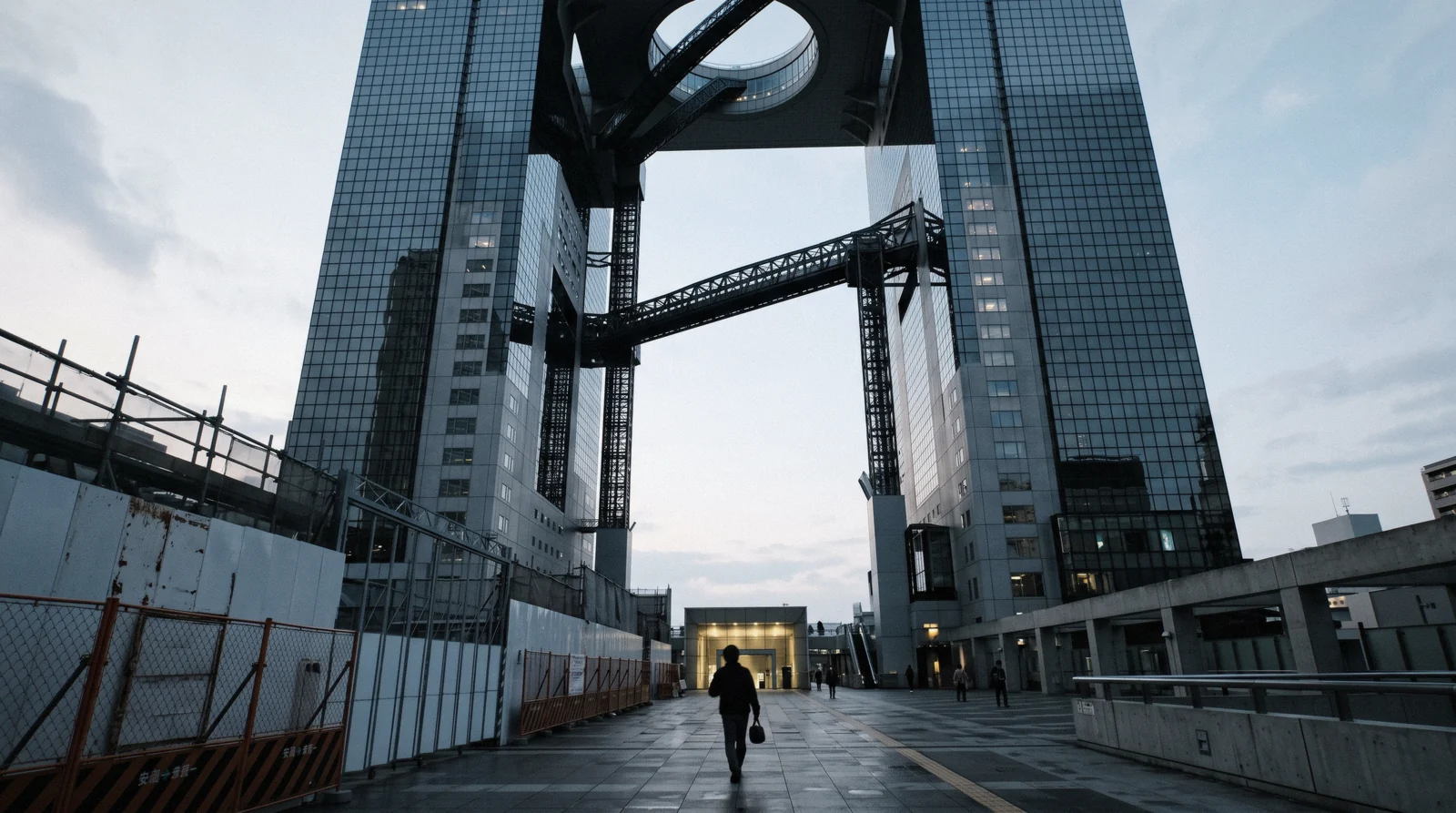
Umeda Sky Building
The Umeda Sky Building is the pair of forty-storey towers north of Osaka Station that are joined at the top by a doughnut-shaped roof, and the thing that makes it worth the fare is that you can walk out onto that roof with nothing above you. Osaka's other two decks put glass between you and the city. This one does not, which is why the ring is booked out at sunset and quiet by ten at night. Everything else on the observatory — the price, the hours, the escalator across the void, the entrance almost everyone gets wrong — is below, and the rest of the city is on the Osaka city guide homepage.
Quick answer Price, hours, the open roof and the entrance people miss — in five lines
The Floating Garden Observatory costs $12.54 (¥2,000) for adults and $3.14 (¥500) for children from four to elementary school, opens 09:30 to 22:30 with last admission at 22:00, and takes no reservation at all — a web ticket carries a date, never an hour. Its top level is an open-air ring around the roof, which no other observation deck in Osaka has. Read on the observatory's own site. Dollar figures throughout this page use the European Central Bank rate of ¥1,000 to $6.27.
Key takeaways
- Go up for the roof, not the windows — the ring is open to the sky, and on a windy or wet evening staff can close it while the indoor floors below stay open
- The Osaka Amazing Pass admits you free only until 15:00; arrive after that and the pass is worth 10 per cent off, which is the single most misreported fact about this building
- The observatory entrance is not inside the towers and the office lifts do not reach it — walk to the dedicated entrance at ground level, then the ticket counter is on the 39th floor
- A four-hour guided walk with the admission included covers the deck, the underground arcades and Nakazakicho; the evening version is timed for sunset on the roof and carries on into the Shinsekai neon
- Deciding between this and the other two decks? The three-deck comparison sets the prices, the heights and the booking rules side by side
Key facts
Opening hours
| Floating Garden Observatory, daily | 09:30–22:30 |
|---|---|
| Last admission | 09:30–22:00 |
| Shortened, 8 November 2026 | 09:30–19:00 |
| Shortened, 18 April 2027 | 09:30–18:00 |
Closed None published. Two inspection days run short — 8 November 2026 to 19:00 (final admission 18:30) and 18 April 2027 to 18:00 (last admission 17:30) — and the roof itself can be shut in bad weather while the indoor floors stay open
Admission
- Adult
- $12.54 (¥2,000)
- Reduced
- $3.14 (¥500) age four to elementary school; half the normal fare for a disability-certificate holder and up to the same number of carers, on production of the original booklet at the reception counter
- Free
- Under four; tour leaders escorting a group, with proof; one teacher per ten pupils on a school booking
Planning it
- Time needed
- Not stated by the operator; our routing: 45 to 60 minutes, or 90 if you eat on the 40th floor
- Book ahead
- Optional — walk-up usually fine
- Address
- 1-1-88 Oyodonaka, Kita-ku, Osaka 531-6039 — the observatory has its own entrance, outside the towers
Four ways up, priced from the observatory's own page and from GetYourGuide in Q3 2026. The venue wants ¥2,000 at the 39th-floor counter or online with a chosen date.
The counter wants $12.54 (¥2,000) and nothing below sells the view for less, so the question is what you add to it. The guided options start at $56.62 with that admission folded in.
| Option | Price | Includes | Cancel | Book |
|---|---|---|---|---|
| Official admission, adultAnyone going up on their own; a web ticket carries a date | $12.54 (¥2,000) | All three observatory levels including the open roof | Web tickets carry a date; the page states no refund policy | Official site |
| Official admission, childAges four to elementary school; under-fours go free | $3.14 (¥500) | Ages four to elementary school; under four free | Same terms as the adult ticket | Official site |
| Guided half-day: deck, underground mall, NakazakichoA half day that also covers the underground mall and Nakazakicho | Listed at $56.62 | Admission, English-speaking guide, four hours | Free up to 24 hours before | Check Availability |
| Evening walk: sunset on the roof, then ShinsekaiSunset on the open roof, carried on into Shinsekai afterwards | Listed at $69.92 | Observatory ticket, guide, photographs of you | Free up to 24 hours before | Check Availability |
| Admission with a private car from your hotel and backVisitors who want a door-to-door car with the ticket, tolls and parking handled | Listed at $199.76 | The ¥2,000 ticket, private round-trip transfer, tolls, parking | Free up to 24 hours before | Check Availability |
The guided options cost several times that because you are buying a guide and, in one case, a car — the admission inside them is still the same ¥2,000 ticket. Be clear about what the last row is. At $199.76 it is a private vehicle with a $12.54 (¥2,000) admission ticket inside it — roughly ninety-four per cent of the price is the car and the driver, who the listing says speaks Japanese and Chinese. That can be sound value for four or five people splitting one fare, and poor value for two travellers who can walk from Osaka Station in seven minutes. We would not book it for the ticket.
Umeda Sky Building entry options compared
Every card links to the operator's own page, where the live calendar shows what is still open for your date. Prices are the platform's USD listings, and the operator charges in your own currency at checkout.
 from $56.62
Osaka: Umeda Sky, Underground Mall & Nakazakicho Walk
Four hours with the ¥2,000 Floating Garden admission included, then the Whity Umeda arcades underground and the old houses and cafes of Nakazakicho. The guiding is what you are paying for; four ratings so far.
Check Availability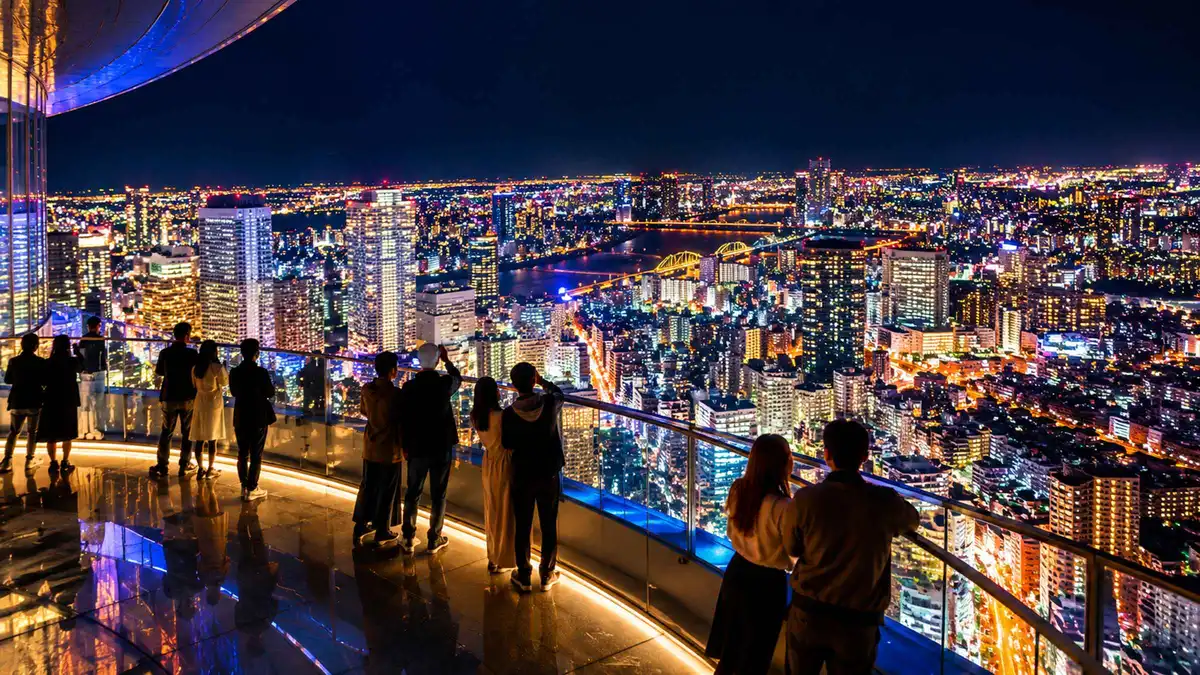 from $69.92
Osaka Night: Umeda Sky Building + Shinsekai Neon
Timed for sunset on the open roof at Umeda, then down into the Shinsekai neon, with the observatory ticket included and the guide taking your photographs. A new listing, so there are no ratings behind it yet.
Check Availability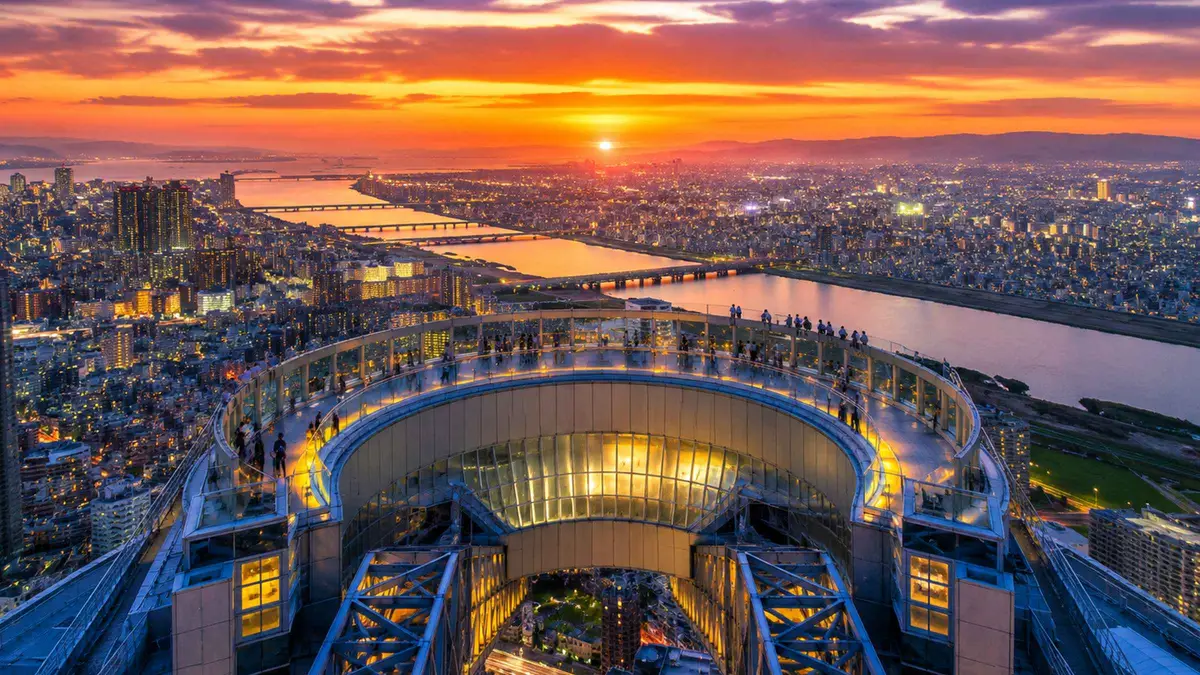 from $199.76
Osaka: Umeda Sky Ticket & Private Transfer
A private car from your hotel and back with the ¥2,000 observatory ticket included — almost the whole price is the vehicle. It makes sense for a group splitting the fare or anyone who wants a door-to-door ride; the driver speaks Japanese and Chinese.
Check AvailabilityPrices, ratings and details are the platform's own. Dollar figures are the listed prices. The platform bills in your account's currency.
Umeda Sky Building against Osaka's other two decks
Osaka sells three high views and they are not interchangeable. Prices, hours and booking rules below come from each venue's own site, and heights are the Wikidata figures for each structure.
| Deck | Adult ticket | What you stand on | Hours | Booking and passes |
|---|---|---|---|---|
| Umeda Sky Building, Floating Garden | $12.54 (¥2,000) | A 173-metre building; the top level is an open-air ring around the roof, no glass | 09:30–22:30, last admission 22:00 | No slot, walk up. Amazing Pass free only before 15:00, 10% off after |
| Abeno Harukas 300 | $12.41 web advance, $13.79 at the counter (¥1,980 / ¥2,200) | A 300-metre tower; a floor-to-ceiling glass corridor on 60, an open-air atrium on 58 | 09:00–22:00, last admission 21:30 | No slot. Not on the Amazing Pass free list at all |
| Tsutenkaku | $9.41 (¥1,500) | A 108-metre tower; general deck plus a small open outdoor deck above it | 09:00–21:45, last admission 21:15 | Timed reservation required for every ticket, pass holders included |
Read from the Umeda side the question is simple: you are paying a middling price for the only roof in the city that is open to the sky. Our reading: if you are only going up once, come here. Harukas is 127 metres higher and the view is genuinely wider — Kyoto, the Rokko range and the Akashi Kaikyo Bridge on a clear day — but it is a glass corridor, and glass photographs badly at night. Tsutenkaku is the cheapest and the most fun, and it is a tower in a neighbourhood rather than a view over one. Full arguments on the Abeno Harukas and Tsutenkaku pages.
What the Floating Garden actually is
Two towers, a hole in the middle, and a roof you walk on. The building is stranger than the photographs suggest.
Hiroshi Hara designed the complex, Takenaka built it, and it opened to the public on 25 March 1993 as the surviving half of a four-tower scheme called the City of Air — the 1980s bubble collapsed and towers three and four were never built. What went up is two forty-storey blocks linked at the top by a ring-shaped platform with a circular void through its centre. The roof section was assembled at ground level and jacked into position by hydraulic lifts, the first time a building had been finished that way, and the glass escalators that cross the gap between the towers went up by the same method. All of that is from the English Wikipedia article, which puts the towers at 170 metres to the roof and 190 metres including the spires; Wikidata records the building at 173 metres. The sources disagree by three metres and neither is the operator, which publishes no height at all.
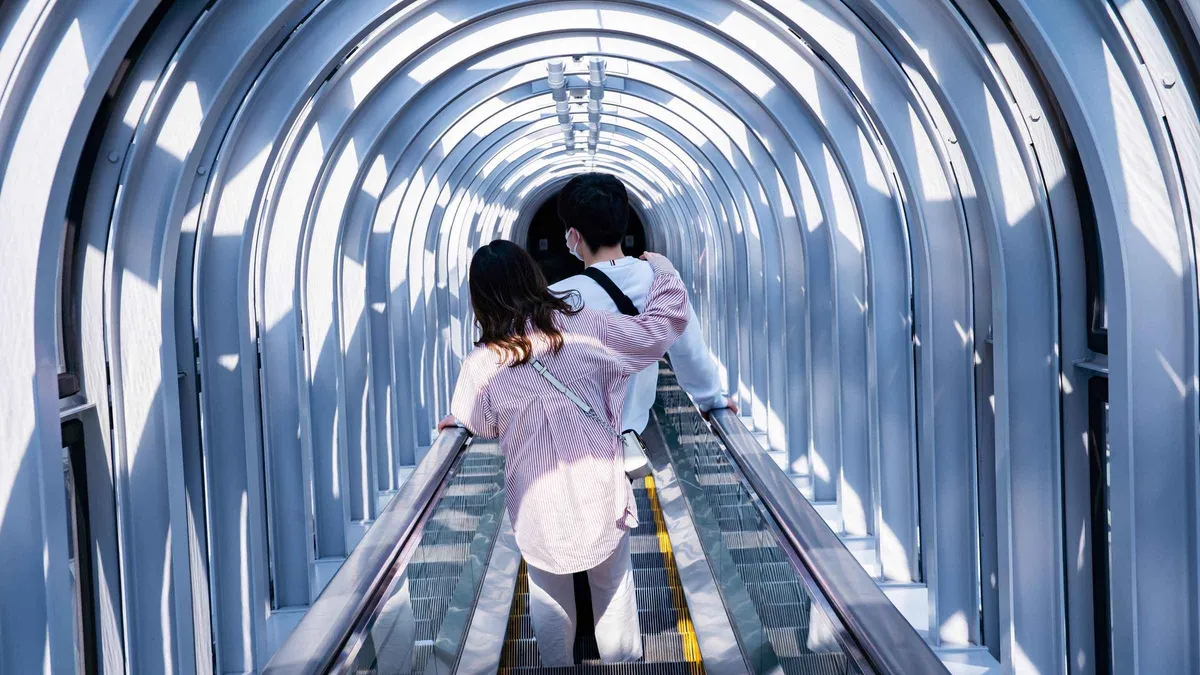
The observatory occupies the top of that structure across three levels. The 39th floor is the arrival lobby with the ticket counter, the shop and the restaurants; the 40th is a gallery with windows on every side and cafe SKY 40; and above them is the roof — the Sky Walk, open to the weather, with the Lumi Sky Walk lighting under your feet after dark. Two floors below the lobby the escalator crosses the void, which is the piece of the visit people actually remember: you ride up through open air with the ground thirty-five storeys below and the two towers on either side. Seeing the city spread out from the Sky Walk is one thing, and an osaka guided tours osaka guided tours can put that view in context on the way up.
The floors, in the order you meet them
The operator numbers the visit as a route rather than a building, and it helps to know what is coming before you buy.
| Level | What is there | Worth knowing |
|---|---|---|
| 3F — the departure gate | The start of the route up from the dedicated entrance | Not reachable from the Tower East or Tower West lifts |
| 35F to 39F — the sky escalator | Glass escalators crossing the open gap between the towers | The single best thing in the building, and it is free of charge to anyone with a ticket |
| 39F — the sky lobby | Ticket counter, gallery shop, Chinese restaurant, Sky Lounge Stardust, guided-tour base | Same-day tickets are sold here, not at street level |
| 40F — the gallery | Windows on all four sides, cafe SKY 40, the city and river views | Where you go when the roof is closed for weather |
| RF — the Sky Walk | The open-air ring around the roof, the Lumi Sky Walk lighting, the padlock fence | The reason to come; closed without notice in high wind or heavy rain |
The other things in the building
The Koji Kinutani Tenku Art Museum sits on the 27th floor of Tower West and sells a combined ticket with the observatory — but only as a same-day counter purchase, never as a web ticket. Its own admission is $8.15 (¥1,300) for adults and $5.02 (¥800) for junior high, high school and university students, it opens 10:00 to 18:00 and closes on Tuesdays. In the basement, Takimi Koji is a recreated Showa-era lane of small restaurants, which is where to eat if the 39th-floor prices put you off.
Both sets of figures come from the Osaka Amazing Pass facility list and the observatory's own ticket page.
Hours, the two short days and the New-Year sunrise
The observatory publishes no closed days at all, and instead publishes a short list of dates when the hours move. Those dates are the ones worth checking before you book a flight around a view.
Normal operation is 09:30 to 22:30 with the last admission at 22:00, every day, all year. The operator states plainly that hours may change without notice, and it keeps a special-operations table for the exceptions. On 2 September 2026 that table held four entries, and only one of them appears on any English-language guide we checked.
| Date | What changes | Why |
|---|---|---|
| Sunday 8 November 2026 | 09:30–19:00, last admission 18:30 | Facility inspection |
| Saturday 17 October 2026 | Special fireworks operation for the Naniwa Yodogawa festival | The observatory's own event listing; the ticket page still says the date is undecided |
| Sunday 18 April 2027 | 09:30–18:00, last admission 17:30 | Facility inspection |
| New Year's Day | A 06:00–08:00 sunrise opening, web ticket only | The special-operations table gives 1 January 2026, not yet rolled forward to 2027 |
The fireworks contradiction, and what to do about it
This is worth spelling out because it decides a date. The observatory's ticket page lists the Naniwa Yodogawa fireworks special opening as "2026 — undecided", while the observatory's own front page announces it for Saturday 17 October 2026. The festival did move to that date this year. Treat the front page as current, expect a separate viewing ticket rather than ordinary admission, and expect it to sell before the day: Abeno Harukas had already sold out its fireworks tickets when we read its page. The full festival calendar is on the Osaka festivals page.
The New-Year line is a similar trap in the other direction. The sunrise opening is a real product — 06:00 to 08:00, web ticket only, no counter sales — but the entry on the page still carries the January 2026 date, so nobody should book flights on it for 2027 until the operator reprints it.
When to go, if the hour is yours to choose
The half hour on either side of sunset is the best view and the worst queue, and that queue forms at the 39th-floor counter because the same-day and web tickets share the same lifts. Two workarounds: buy the dated web ticket in the morning and come back, which takes you past the till without booking an hour; or come after 21:00, when the roof is close to empty, the ring is lit and the city below is at its brightest. The building keeps admitting until 22:00.
The one thing you cannot plan around is weather. The operator states that the roof may be closed in severe conditions with no notice and no refund — you keep the 39th and 40th floors and lose the reason you came. If your date is fixed and the forecast is filthy, the Abeno Harukas glass corridor is the safer indoor view.
The entrance almost everyone gets wrong
The operator devotes a red-boxed notice on three separate pages to one instruction, which tells you how often it goes wrong.
You cannot reach the observatory from the Tower East or Tower West lifts, and you cannot use the office lifts. The observatory has a dedicated entrance, and — the operator's own emphasis — that entrance is not inside the building. You walk to it at ground level, and the route up starts from the 3rd-floor departure gate. Wheelchair users are the exception and are directed to the high-rise lift from Tower East 1F.
On foot the building is closer than its reputation: seven minutes from JR Osaka Station, nine from Hankyu Osaka-umeda, nine from the Osaka Metro Midosuji Line at Umeda. All three routes end the same way — down a flight of steps into a 40-metre underpass, up the other side, and the building is across the road. That underpass is the bit people photograph and complain about; it is short, lit, and signed, and it exists because a wide road sits between Grand Front Osaka and Shin-Umeda City. The getting around Osaka page has the fares if you are riding rather than walking, at $1.19 to $2.45 (¥190 to ¥390) a Metro trip by zone.
Driving, and why not to
There is a 460-space car park under the building at $3.14 (¥500) for the first hour and $1.57 (¥250) per half hour after, and a 139-space bicycle park where the first hour is free. Coaches pay a flat $12.54 (¥2,000) an hour from 1 April 2026, announced on 9 February. For two people from central Osaka the car park costs more than an admission ticket and the walk from Osaka Station takes seven minutes: drive only if you were driving anyway.
At the counter
Same-day tickets are sold on the 39th floor, paid by cash, credit card or contracted coupon. A disability certificate must be the original, shown at the reception counter, and it brings the holder and up to the same number of companions to half fare. Groups of ten or more have their own rate on a separate page.
One thing that still circulates: the free-entry-on-your-birthday scheme ended on 1 July 2018 and has not come back.
Is ¥2,000 worth it?
The honest case for and against, in the terms a visitor actually decides on.
Go if you want a photograph of Osaka that is not taken through glass, if you are within walking distance of Osaka Station with an evening free, or if you are travelling with someone who enjoys the getting-there as much as the arriving — the escalator through the void does more work than the view does. At $12.54 (¥2,000) it costs less than an hour in most Osaka museums and about the same as two Metro trips and a coffee.
Skip it if you are counting yen and have already booked Tsutenkaku, which is ¥500 cheaper and has its own open deck; if the forecast has wind in it, because the roof is the ticket and the roof closes; or if what you want is distance and geography, in which case Abeno Harukas is 127 metres higher and shows you the Rokko mountains and the Akashi Kaikyo Bridge on a clear day.
The one thing this deck has that no amount of height replaces: the sky is directly above you, the wind is real, and the Yodo River bends away to the north-west with the whole Kita skyline stacked in front of it. That is a different photograph from a window.
The pass arithmetic, which is not what the pass pages imply
The observatory sits on the Osaka Amazing Pass free list, and the pass's own facility page carries a condition that almost nothing else repeats: admission with the pass applies until 15:00, and from 15:00 the pass gets you 10 per cent off instead. Since the reason to come here is the light between five and nine in the evening, the free entry and the good view do not overlap. Read that against the pass price — $21.90 (¥3,500) for one day, $31.40 (¥5,000) for two — and this deck stops being a reason to buy it.
The Osaka e-Pass, at $12.54 (¥2,000) for a day and entries only with no transport, also lists this observatory among its facilities and prints no time limit on its own overview page, but it does not publish its full list either. Our reading of both is on the Osaka Amazing Pass page, and the wider ticket picture is on the Osaka attraction tickets hub.
Umeda Sky Building map: the walk from the station and what is around it
The building, the three stations people walk from, and the next stops within reach on foot or one Metro ride.
The observatory publishes an address rather than a latitude, so its pin uses the Wikidata coordinate for the building; the others use each venue's own figure. Map tiles are OpenStreetMap.
Next stop from the Umeda Sky Building
Walking times are our estimates from the routes the venues publish.
Umeda
The district the building stands on the edge of — three railway terminals, the Whity and Diamor arcades underground, and the department stores between them.
8 minutes on footNakanoshima
The island between the Dojima and Tosabori rivers, about three kilometres long and fifty hectares, with the concentration of Osaka's art museums on it.
Two Metro stops, $1.19 (¥190)Where to stay in Osaka
Why sleeping near Osaka Station buys you the airport trains, the Kyoto trains and a seven-minute walk to this roof.
The Kita side of the cityUmeda Sky Building questions
How much is the Umeda Sky Building observatory?
$12.54 (¥2,000) for adults and $3.14 (¥500) for children from age four to the end of elementary school, with under-fours free. A disability certificate brings the holder and up to the same number of carers to half fare, on production of the original booklet at the reception counter. Those are the operator's own figures. The guided half-day walk includes the same admission inside its price.
What are the Umeda Sky Building hours?
09:30 to 22:30 daily, with last admission at 22:00. No closed days are published. Two dates run short for inspection — 8 November 2026 to 19:00 and 18 April 2027 to 18:00 — and the operator warns that hours can change without notice. It also runs a 06:00 to 08:00 New-Year sunrise opening sold as a web ticket only.
Do you need to book Umeda Sky Building tickets in advance?
No. There is no timed slot and no reservation system. The web ticket carries a date you choose and takes you past the till, and same-day tickets are sold at the 39th-floor counter. The only queue worth avoiding is the one that builds at that counter around sunset. Booking matters at Tsutenkaku instead, where a time slot is now compulsory for every ticket.
How tall is the Umeda Sky Building?
The sources do not quite agree, and the operator publishes no height at all. Wikidata records the building at 173 metres; the English Wikipedia article gives 170 metres to the roof and 190 metres including the spires. All of them are talking about a forty-storey pair of towers, and the observatory sits on floors 39 and 40 plus the roof above them. For height alone, Abeno Harukas 300 is 300 metres and Tsutenkaku 108.
Where is the Umeda Sky Building entrance?
At ground level, in its own dedicated entrance that is not inside the towers — the operator repeats this on three separate pages because the Tower East and Tower West lifts do not reach the observatory and the office lifts cannot be used. Wheelchair users are the exception and take the high-rise lift from Tower East 1F. It is seven minutes on foot from JR Osaka Station and nine from Hankyu Osaka-umeda, both ending in a short underpass.
Is the Umeda Sky Building better at day or at night?
At night, and the operator's own hours agree — it stays open until 22:30 while the city's other decks close earlier. The roof ring is lit from below by the Lumi Sky Walk, the Kita skyline is at its densest after dark, and the last ninety minutes before the 22:00 cut-off are the quietest of the day. Daylight has one advantage: on a clear morning you can follow the Yodo River out towards the bay.
How long does the Umeda Sky Building take?
The operator does not publish a duration. Our routing: 45 to 60 minutes from the ground-level entrance to being back outside, of which fifteen are the escalator and the lobby and the rest is the roof. Allow 90 minutes if you plan to sit down at cafe SKY 40 on the 40th floor, and add the walk from your station — seven to nine minutes from any of the three Umeda terminals.
Is the Floating Garden Observatory open in the rain?
The indoor levels are. The roof ring is open to the weather and the operator states it may be closed in severe conditions, without notice and without a refund, so a wet or windy evening can leave you with the 39th and 40th floors only. If your date is fixed and the forecast is bad, the glass corridor at Abeno Harukas is the indoor alternative.
Where the Umeda Sky Building fits in an Osaka day
It is an evening, not an afternoon, and it pairs with the north of the city rather than the south.
The building's value is at the end of a day, not the middle of one. A workable Kita evening: the Nakanoshima museums until they close at five, twenty minutes back north on the Midosuji Line and on foot, the roof at sunset, dinner in the basement Showa lane. That sequence uses the two hours when nothing else in Osaka is open and the deck is at its best.
What it is not is a stop to squeeze between Osaka Castle and Dotonbori at two in the afternoon, which is where most itineraries put it and where the Amazing Pass's 15:00 free-entry cut-off pushes people. Midday light flattens the city and the roof gives you nothing a window would not. Our routes place it in an evening slot — see Osaka in 2 days and Osaka in 3 days — and the things to do in Osaka hub ranks it against everything else competing for that evening.
The Floating Garden on film: the escalator, the ring and the view
Three walk-throughs, each id copied from our own verified list rather than typed from memory and each checked against YouTube's oEmbed record and its thumbnail. They show what the building looks like at the pace you would actually move through it.
Discovering Umeda Sky Building Floating Garden: Complete Guide, Travel Tips & Transportation Map
Follows the walking route in from the station and up through the escalator, which is the part this page warns about.
Video: HAI Mingle TravelUMEDA SKY BUILDING Osaka Japan walking tour 4K | Travel Guide | 360 degree observatory
An unedited walk around the open roof ring, which is the thing the other two Osaka decks do not have.
Video: Travelmama Tips & InspirationUmeda Sky Building: TOURIST TRAP or BREATHTAKING Views?
Argues the case both ways on whether the admission is worth it — useful before you spend the ¥2,000.
Video: Bec TriesVideos load from YouTube only when you press play.
Prices, hours and terms are set by the venue or operator and confirmed at checkout.
We may earn a commission if you book through one of our links, at no extra cost to you. Full affiliate disclosure