 Osaka City Guide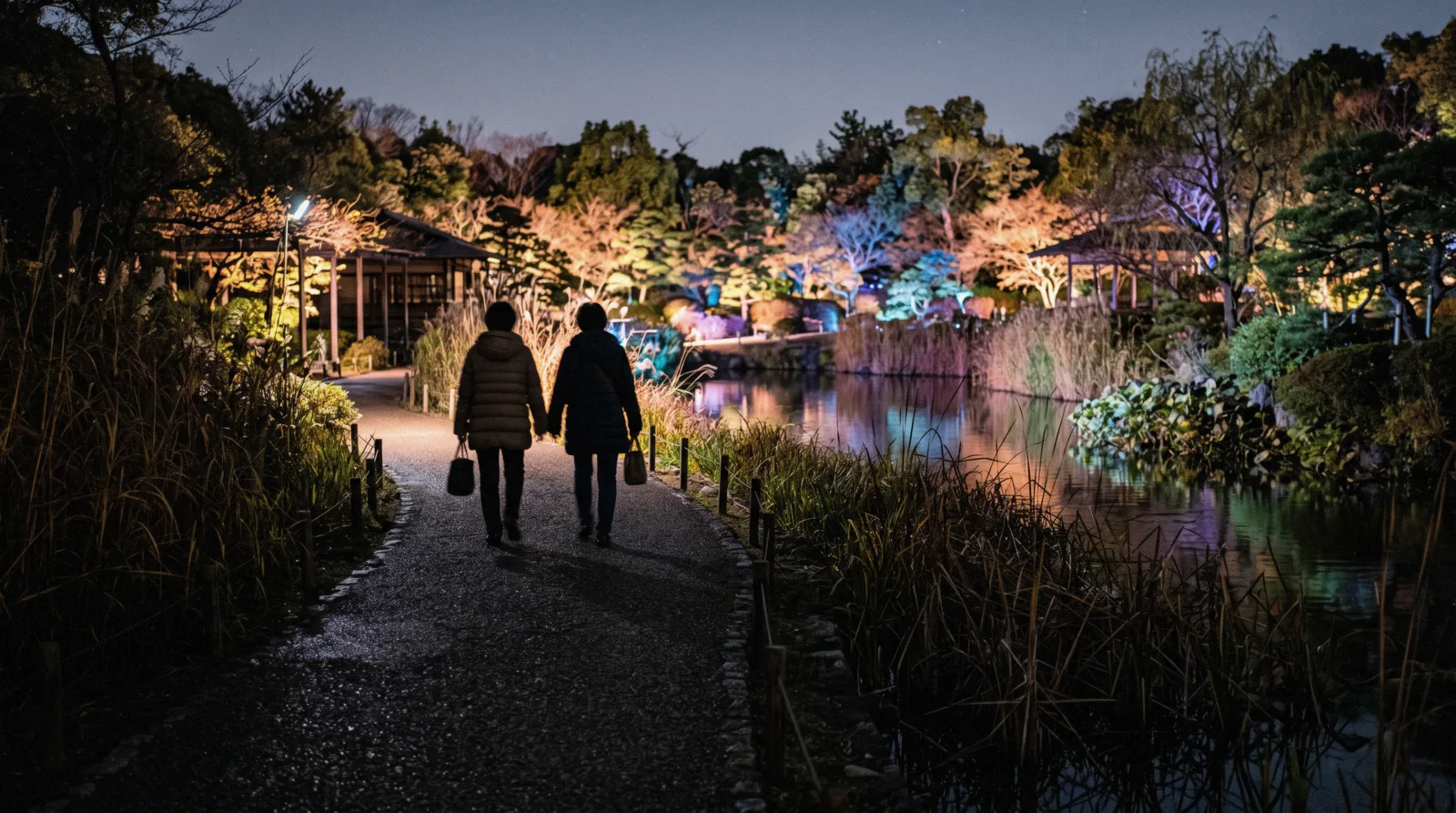
teamLab Osaka: The Night Museum in Nagai Botanical Garden
teamLab Osaka is not a building. It is a 24-hectare municipal botanical garden in the south of the city that switches the lights on after sunset and becomes an open-air museum until half past nine, and almost everything that goes wrong with a visit comes from booking it as though it were a gallery. The opening time moves every two weeks with the sunset, the garden shuts on Mondays that follow no pattern, the price changes with the date, and the paths are unlit soil under trees. Get those four things right and it is the best two hours of what to see in Osaka after dark. This page carries the dated calendar, the routes from the stations that serve Nagai Park, and the rules teamLab prints and most guides skip. Dollar figures are approximations at ¥1,000 ≈ $6.27 (European Central Bank reference rate via frankfurter.dev).
Quick answer The dated price, the moving opening time, the Mondays that close, and what to wear
teamLab Osaka opens only after dark in Nagai Botanical Garden and closes at 21:30, with final admission at 20:30 on every date up to 27 October 2026. The adult ticket is priced by date between $11.29 and $15.05 (¥1,800 and ¥2,400), the ticket carries a date and a one-hour entry window, and re-entry is not allowed. From teamLab's own exhibition page and its official ticket calendar.
Key takeaways
- The opening time moves every fortnight — 19:00 to 13 September 2026, 18:30 from 15 September, 18:15 from 1 October, 18:00 from 10 October — but last admission stays at 20:30, so a later opening means a shorter window, not a later one
- It closes on irregular Mondays — 24 August, 14 September, 28 September and 26 October 2026 — published nowhere but the ticket calendar, which is why a Monday in Osaka needs planning
- Buy on the official site, not at the gate: a gate ticket is same-day only, priced differently and can sell out, while the GetYourGuide entry ticket cancels free up to 24 hours before
- Wear trainers and long sleeves. The paths are unlit, unpaved and under trees, and teamLab's own notes tell you to bring insect repellent
Key facts
Opening hours
| 1–13 September 2026 | 19:00–21:30 |
|---|---|
| 15–30 September 2026 | 18:30–21:30 |
| 1–9 October 2026 | 18:15–21:30 |
| 10–27 October 2026 | 18:00–21:30 |
| 28–31 October 2026 | 18:00–22:30 |
| Last admission, all dates to 27 October | —–20:30 |
Closed Irregular Mondays — 24 August, 14 September, 28 September and 26 October 2026. teamLab calls them 不定期 (irregular) and publishes them only on the ticket calendar, so no weekday is safe by assumption
Admission
- Adult
- $11.29–$15.05 by date (¥1,800–¥2,400); 20 September 2026 was priced at $12.54 (¥2,000)
- Reduced
- $3.76 (¥600) elementary and junior high school; $6.27 (¥1,000) for a disability-certificate holder and one companion, certificates issued in any country accepted, Mirairo ID accepted in place of the booklet
- Free
- Preschool children — no ticket is issued and none is needed
Planning it
- Time needed
- Not stated by teamLab; our routing: 90 minutes to two hours, and the ticket does not cap your stay
- Book ahead
- Essential — weeks ahead
- Address
- Nagai Botanical Garden, 1-23 Nagai Koen, Higashisumiyoshi-ku, Osaka
There are only two ways in: teamLab's own timed ticket site, and a reseller card. The official row carries the venue's untracked link.
Every route in is a timed evening slot, so the only question is where you buy it: teamLab's own site from $11.29 (¥1,800) with three date changes allowed, or the reseller card at $11.86 that cancels instead.
| Ticket | Price | What it covers | Change or cancel | Book |
|---|---|---|---|---|
| Official online ticket, adultMost adults — the price follows the date, and the slot can be moved three times | $11.29–$15.05 by date (¥1,800–¥2,400) | A named date and a one-hour entry window; no cap on how long you stay | No cancellation; the date and time can be changed three times, up to 21:00 on the day | Official site |
| Official online ticket, childElementary and junior high children; preschoolers need no ticket at all | $3.76 (¥600) | Elementary and junior high school; preschool children need no ticket at all | Same rules; a guardian aged 18 or over must come, one per three children | Official site |
| Official online ticket, disability rateCertificate holders and one companion, who must enter together for the check | $6.27 (¥1,000) | The certificate holder and one companion, each on their own ticket; certificates issued abroad accepted | Same rules; the booklet or Mirairo ID is checked at the gate, so enter together | Official site |
| At the gate on the dayOnly if you decide on the night, and only while stock lasts — no date change after | Not published in advance — teamLab says only that it differs from the online price | Same admission, sold only for that evening and only while stock lasts | No date change is possible on a gate ticket | Official site |
| GetYourGuide entry ticketAnyone who would rather cancel for a refund than reschedule the date | Listed at $11.86 | Entry to teamLab Botanical Garden Osaka | Free cancellation up to 24 hours before the start time | Check Availability |
Yen figures are teamLab's own, read from its official ticket calendar in Q3 2026, and the GetYourGuide listing was read the same day; dollar conversions use ¥1,000 ≈ $6.27, while the GetYourGuide figure is the platform's own listed USD. The change rule is the reason to buy from teamLab directly: an official ticket can be moved three times through the "change entry date" button on the QR ticket, right up to 21:00 on the day it is booked for. teamLab lists what cannot be changed — a ticket already changed three times, a change to a different ticket type, a move to a sold-out date, part of a multi-ticket order, and a move to a date at a different price. Resale is banned and a resold ticket will not admit you.
The ticket, and the tours that reach it
One product actually sells this venue — the entry ticket. The three city walks below are here because Nagai sits a long way south of the centre and many readers pair a late afternoon in town with the garden after dark; none of them includes teamLab, and each card says so. Prices are the platform's listed USD.
 from $11.86
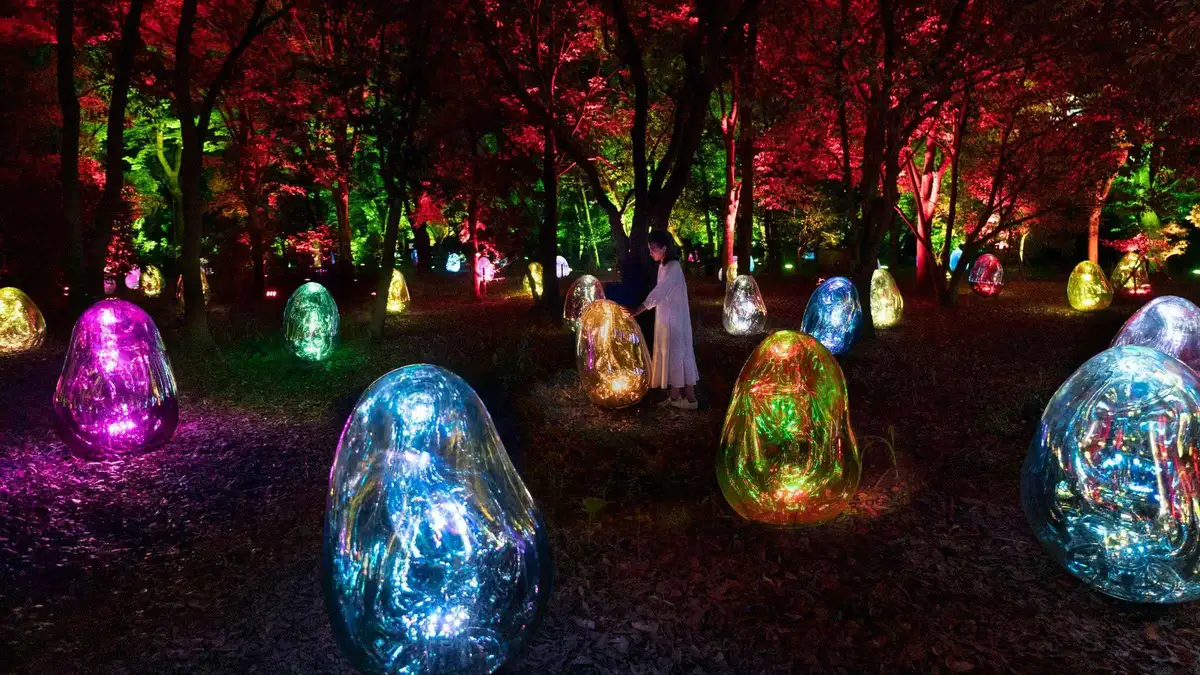
Osaka: teamLab Botanical Garden Entry Ticket
A date-and-time ticket for the night-only art walk through Nagai Botanical Garden. The venue prices by date, ¥1,800–¥2,400, so this sits mid-range; closing times shift by season and re-entry is not allowed.
Check Availability from $35.71
Osaka: Private or Group Hotspots & Hidden Gems Walking Tour
A three-hour walk that stretches to seven if you want it to, private or shared, with a takoyaki and a retro vending-machine drink included. The longer options use trains, which you pay for — usually under ¥1,000 a head.
Check Availability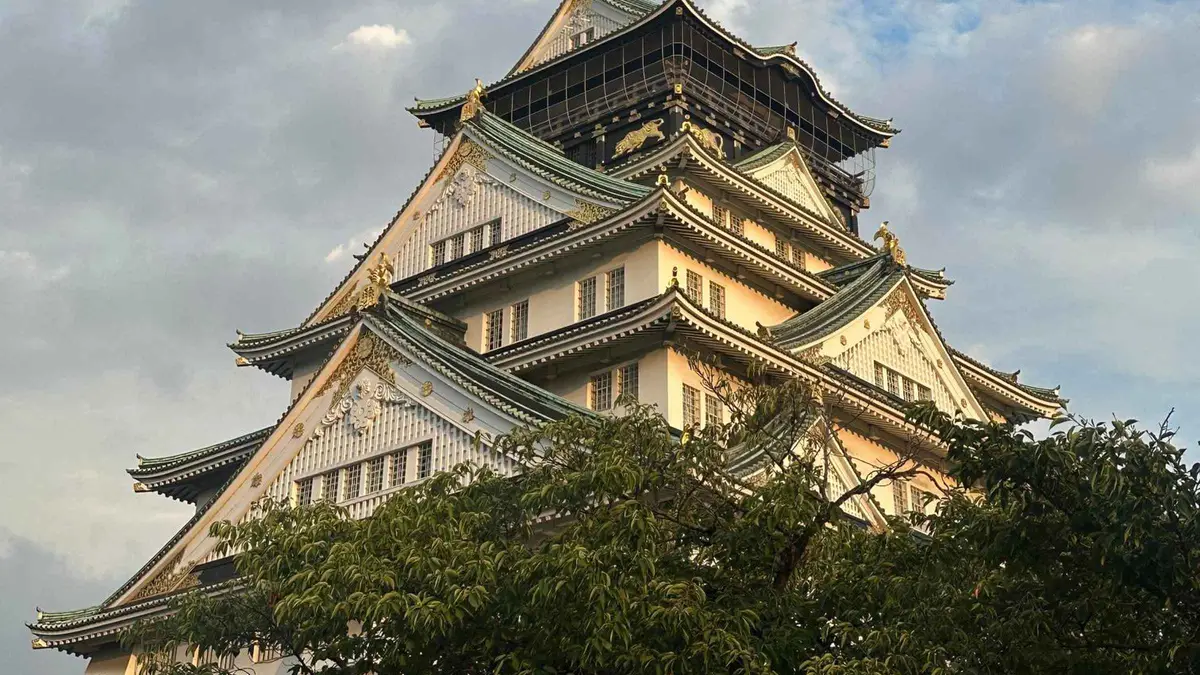 from $49.74
Osaka: Essential City Loop Tour with Local Guide
Five hours in a group of eight covering the castle, the Showa-era backstreets and the neon strip in one loop, with food bought stop by stop instead of a sit-down lunch. Only four people have rated it so far.
Check Availability from $54.56
Osaka: Guided Walking Tour with a Native Expert – Top Sights
Four hours linking Osaka Castle, Tsutenkaku and Namba by metro, with the ¥1,200 keep admission included and the ¥430 of train fares not. A Japan Rail Pass buys you nothing here — the route runs on Osaka Metro.
Check AvailabilityPrices, ratings and details are the platform's own. Dollar figures are the listed prices. The platform bills in your account's currency.
What teamLab Osaka actually is, and what it is not
A permanent night exhibition installed inside a working municipal botanical garden, open since 29 July 2022.
Nagai Botanical Garden opened in 1974 inside Nagai Park, which itself opened in 1944 as a general park with a baseball ground. It covers about 240,000 square metres, has a large lake at its centre, and — teamLab's own text makes a point of this — after fifty years supports enough wild bird life that goshawks and owls are seen in it. That matters to the art, because the works are built out of the garden rather than dropped into it.
The project teamLab runs here is called Digitized Nature: nature becoming art without being altered, using only light, sound and sensing. The trees are not lit theatrically from outside. Each responds when a person or an animal moves near it, brightens, sounds a note and passes the change on to its neighbours, so a wave of light rolling towards you through the dark means somebody is walking on the far side of the wood. That is what separates this from a projection show.
There is no set order — teamLab prints 順路はございません — and no fixed line-up either: it states plainly that works and their specifications change with the season, and that in busy periods or during maintenance some pieces cannot be experienced at all.
The works, by area
The venue map is lettered A to G, and the pieces visitors photograph most are the ovoids and the lake. In the camellia garden two versions of Resonating Microcosms stand in the dark, one shifting through 61 solidified light colours, the other through 57 liquified ones: push an ovoid, or let wind or rain move it, and it rights itself, flares and rings a note that runs through the ones around it. The eucalyptus lawn holds Forest of Autonomous Resonating Life, the same behaviour packed dense.
On Oike, the big lake, Floating Resonating Lamps — Fire drift and answer each other out to the wooded island. Above that island stands Sculptures of Dissipative Birds in the Wind, which teamLab describes as drawing the energy the garden's real birds have given the air since sunrise — if no birds fly near it, the sculpture is dark and, in teamLab's words, effectively does not exist.
In the secondary woodland at the garden's edge are Universe of Fire Particles in the Forest and Walk, Walk, Walk, a procession of anonymous figures generated live by program rather than played back, so the image in front of you has never existed before and will not again. Pillars that Dance with the Wind stands in the open at G-1, held up by air moving through it, and teamLab warns it is not shown in rain or strong wind. Because the exhibition only exists after dark, guided tours in Osaka built around the city's evening hours pair naturally with a night at Nagai Botanical Garden.
The calendar is the hard part: dated prices, moving hours, irregular Mondays
Three variables move on this exhibition, and each is published in a different place on teamLab's ticket site. The table below puts them together.
The pattern is easy once you see it. teamLab opens the garden at dusk, and dusk moves, so through the autumn the opening time walks backwards in fortnightly steps — but the closing time stays pinned at 21:30, so an earlier opening buys a longer evening rather than a later one. Last admission is 20:30 throughout, and that is the number that catches people out: turn up at 20:45 with a ticket in your hand and you do not get in. teamLab says so in its own visitor notes and gives no grace period.
The exception is the last four days of October, when the exhibition runs to 22:30 and last admission moves to 21:30. If your dates allow it, that stretch is the one to pick.
| Dates in 2026 | Opens | Closes | Last admission | Admission window |
|---|---|---|---|---|
| 1–13 September | 19:00 | 21:30 | 20:30 | 90 minutes — the shortest of the autumn |
| 15–30 September | 18:30 | 21:30 | 20:30 | 2 hours; closed 14 and 28 September |
| 1–9 October | 18:15 | 21:30 | 20:30 | 2 h 15 min |
| 10–27 October | 18:00 | 21:30 | 20:30 | 2 h 30 min; closed 26 October |
| 28–31 October | 18:00 | 22:30 | 21:30 | 4 h 30 min — the long evening |
Why the price changes, and what it changed to
teamLab prices by date in five steps — $11.29, $11.91, $12.54, $13.79 and $15.05 for an adult (¥1,800, ¥1,900, ¥2,000, ¥2,200 and ¥2,400). Weekends and holiday runs sit at the top of the range, ordinary weekdays at the bottom, and the calendar also marks dates as 残りわずか (few left) or 完売 (sold out). One date we can quote exactly: 20 September 2026 was selling at $12.54 (¥2,000) on the calendar.
The child rate does not move. $3.76 (¥600) covers elementary and junior high school, and preschool children are free with no ticket issued at all. The disability rate is $6.27 (¥1,000) and covers the certificate holder and one companion on separate tickets, with the booklet checked at the gate; teamLab accepts certificates issued in any country and the Mirairo ID app in place of the paper. There is no child disability rate, but a child with a certificate can bring one companion on the discounted ticket.
The three-changes rule, and what it is worth
This is the single best argument for buying from teamLab rather than anywhere else. A ticket bought on the official site can have its date and time changed three times, through a button on the QR ticket itself, up to 21:00 on the day the ticket is booked for. Nothing is refundable — teamLab refunds only if it cancels the exhibition — so the change button is the whole of your flexibility.
And you may need it. teamLab suspends or cancels the evening under a storm warning, a heavy-rain warning or advisory, or a thunder advisory, and during an earthquake of shindo 4 or above; cancellations go up on the official site and its social accounts. If the exhibition runs and you simply decide not to come, there is no refund and no travel compensation.
Getting to Nagai Park after dark
Nagai is about eight kilometres south of Namba, and the walk from the station to the gate is longer than most people expect — teamLab flags it itself. The routes below are teamLab's own; fares are Osaka Metro's published zone bands.
The Midosuji line is the answer for almost everyone. It runs from Umeda through Shinsaibashi and Namba and on to Nagai without a change, and Nagai's exit 3 puts you on the right side of the road for the ten-minute walk east to the garden. teamLab's own note is worth repeating: it takes about ten minutes from the station, so leave the margin.
A Metro single from Namba to Nagai falls in the $1.50–$1.82 band (¥240–¥290). If you are also using the metro during the day, the Enjoy Eco Card at $5.14 on a weekday or $3.89 at a weekend (¥820 / ¥620) pays for itself in three rides.
| Route | Station and exit | Walk to the garden | Notes |
|---|---|---|---|
| Osaka Metro Midosuji line | Nagai, exit 3 | About 10 minutes east | The direct route from Umeda, Shinsaibashi and Namba with no change |
| JR Hanwa line | Nagai, east exit | About 12 minutes east | Useful if you are coming from Tennoji or the airport line |
| JR Hanwa line | Tsurugaoka, east exit | About 15 minutes south-east | One stop further north; only worth it if your train stops here and not at Nagai |
| Kintetsu Minami-Osaka line | Harinakano, west exit | About 20 minutes west | The long walk; take it only if you are already on the Kintetsu line |
| Osaka City Bus route 4 | Nagai-higashi stop | About 5 minutes north | Suminoe-koen to Deto Terminal; the shortest walk of any option |
Driving, and getting home
teamLab asks you not to drive, and the reason is capacity: the Nagai Park car parks fill on exhibition evenings. The nearest is the one signed Nagai Botanical Garden-mae, on the south side of the park, and parking is free for the first ten minutes after entry — a rule teamLab dated to January 2026, useful for a drop-off and useless for an evening.
Going home is the part nobody plans. teamLab points visitors to a taxi rank near the park's south-west entrance, which is the practical answer at 21:30 when a few hundred people leave at once and the walk back to Nagai station is dark. Its own line, 06-6699-5120, is answered between 16:00 and 20:30 — that is, only while the show is on.
What to wear, what you cannot bring, and who cannot go
teamLab publishes an unusually long list of visitor conditions, and almost none of it appears in the guides that recommend the place. These are the ones that change a visit.
Shoes first. teamLab says the site is dark, that much of it is unpaved, and that there are drops and unstable footing in many places; it recommends trainers or something you can walk in. Sandals in a wet camellia garden is the commonest mistake here.
Then skin. The garden is a garden, at night, in a wooded park with a lake in it. teamLab tells visitors to avoid exposed skin and to use insect repellent — bring your own, there is none for sale on site. From June to September, when Osaka records between 126 and 197 millimetres of rain a month (Open-Meteo ERA5 normals, 1995–2024), that advice is not optional.
Then temperature. You may queue outdoors before entry when it is busy, and there is no shelter, so bring heat protection in summer and warm layers in the cold months.
The bag and behaviour rules, in full
- Banned inside: alcohol, food including packed meals, anything over 50 cm long, dangerous or strong-smelling items, fresh flowers, and any lidless drink container other than a bottle or flask
- Large luggage means no entry — teamLab offers no storage, so leave it before you set out
- No re-entry once you leave; no limit on how long you stay, up to closing time
- Only assistance dogs may come in
- Wheelchairs can enter, but some works — the eucalyptus area among them — cannot be reached in one; teamLab asks you to ring the main line first
- Some works flash, pulse and play loud sound
- Junior high age and under need a guardian aged 18 or over, one per three children, free preschool children included in the three
- Take your rubbish home, and expect a possible photo-ID check at the gate
- Photography is allowed and media crews sometimes film here — tell a member of staff if you would rather not appear
- The white-sunflower work depends on the flowers actually being in bloom; teamLab tells you to check its latest information before travelling for it
Is teamLab Osaka worth the trip south?
The decision comes down to two things: whether you want the outdoor version of teamLab, and whether your evening can absorb a two-hour round trip.
Go if you want teamLab's outdoor work rather than its indoor work. This is the version built out of real trees, a real lake and real birds, where the art fails if the ecosystem does — teamLab says as much about the bird sculptures, which are dark when no birds fly. Nothing indoors does that, and the scale of a 24-hectare garden is something no room can imitate. It only exists after dark, so it competes with dinner and with Dotonbori at night rather than with daytime sights; pairing it with a late afternoon at Shitennoji or Tennoji Zoo is the routing that works.
Think twice if you have one night in Osaka. From Namba the return trip plus the walk from the station is close to an hour before you have seen anything, and if it rains the pillar work is switched off, the paths are worse and the whole thing can be cancelled outright.
Skip it if your party includes someone who cannot walk unlit, uneven ground for ninety minutes, or a wheelchair user who wants the whole exhibition — teamLab is honest that parts of it are unreachable.
How it differs from teamLab's indoor museums
The question people arrive with is how the Osaka garden compares with teamLab's indoor venues elsewhere in Japan, and the honest answer is that they are different products rather than better and worse. The indoor shows are climate-controlled, projection-led, entirely under teamLab's control and open in daylight. The garden is none of those: it opens only after sunset, it can be cancelled by a thunder advisory, its works are made of things that grow, and it will get your shoes muddy.
If what you liked in photographs was a mirrored room of projected flowers, that is the indoor product. If it was a field of glowing ovoids under trees, that is here.
teamLab Osaka map: the garden, the stations and the walk
The garden inside Nagai Park, the stations that serve it and the walking distances teamLab publishes. Coordinates are Wikidata's; the walking times are teamLab's own.
Nagai Park's own car parks fill on exhibition evenings and teamLab asks visitors to come by train; a taxi rank sits near the park's south-west entrance for the journey home.
What to do before teamLab Osaka opens
Everything here closes before the garden opens, so these are afternoon stops on the same north–south line, not evening ones. Travel times are on the Midosuji line; walking minutes are our estimates.
Tennoji Zoo
Last admission 16:00 and out by 17:00, which lands you at Nagai in time for a 18:00 or 18:30 opening. $5.02 (¥800), closed Mondays, and it runs its own Night ZOO on fourteen dates a year.
Five stops north on the Midosuji lineShitennoji
The Central Precinct closes at 16:00 for $3.14 (¥500). The grounds are the better late-afternoon walk, and it is the oldest thing in the city on a line that ends at a light show.
Four stops north, then five minutes on footOsaka attraction tickets
teamLab is on neither the Osaka Amazing Pass nor the e-Pass, so it is a separate purchase whatever else you hold. The tickets page has the arithmetic on which pass earns its price.
Before you book anythingteamLab Osaka questions
How much are teamLab Osaka tickets?
The adult ticket is priced by date between $11.29 and $15.05 (¥1,800 and ¥2,400); 20 September 2026 was $12.54 (¥2,000) on the official calendar. Elementary and junior high school children pay $3.76 (¥600), preschool children are free and need no ticket at all, and a disability-certificate holder plus one companion pay $6.27 (¥1,000) each. A gate ticket costs a different amount again, which teamLab does not publish in advance — the online ticket is the only price you can know before you travel.
What time does teamLab Osaka open and close?
It closes at 21:30 with final admission at 20:30 on every date up to 27 October 2026, and opens at dusk on a fortnightly ladder: 19:00 from 1 to 13 September, 18:30 from 15 to 30 September, 18:15 from 1 to 9 October and 18:00 from 10 to 27 October. From 28 to 31 October 2026 it runs to 22:30 with last admission at 21:30. Miss the last admission and teamLab will not let you in — it says so itself and offers no grace.
Which Mondays is teamLab Osaka closed?
24 August, 14 September, 28 September and 26 October 2026. teamLab labels the closures 不定期 — irregular — and publishes them only on the ticket calendar, so no weekday is safe by assumption. Osaka's other Monday closures do not line up with these either: Tennoji Zoo shuts every Monday, while the Museum of History shuts on Tuesdays.
Can you re-enter teamLab Osaka?
No — re-entry is not allowed once you leave, and teamLab states it plainly. What it does allow is an unlimited stay: the entry window on your ticket is one hour wide, but nothing pushes you out before closing time. Plan on ninety minutes to two hours, wear trainers and long sleeves for the unlit unpaved paths, and eat before you come, because food cannot be brought in and there is nowhere to leave a bag.
Can teamLab Osaka be cancelled by the weather?
Yes, and it is one of the few venues in the city that says so clearly. teamLab suspends or cancels the evening under a storm warning, a heavy-rain warning or advisory or a thunder advisory, and during an earthquake of shindo 4 or above, and it may delay opening in any weather it judges unsafe. Tickets are refunded only if teamLab cancels — otherwise your protection is the three free date changes, usable up to 21:00 on the day, which is why we point at the official ticket rather than a gate purchase.
How do you get to teamLab Osaka from Namba?
Take the Midosuji line south to Nagai — no change — and leave by exit 3; teamLab puts the walk at about ten minutes east. The fare falls in the $1.50–$1.82 band (¥240–¥290). JR Hanwa's Nagai station east exit is about twelve minutes, Tsurugaoka about fifteen, and Osaka City Bus route 4 to the Nagai-higashi stop is the shortest walk of all at about five minutes. More on fares and passes is on getting around Osaka.
Where teamLab fits in an Osaka day
It is an evening, and it takes the whole of one.
Build the day southwards. Take the Midosuji line down to Tennoji in the early afternoon and use the hours between 14:00 and 17:00 on something that closes at five — the zoo, Shitennoji, or the view from Abeno Harukas, which stays open to 22:00 if you would rather do it afterwards. Eat before 18:00, because you cannot eat inside the garden and there is nothing at the gate. Then ride the five remaining stops to Nagai and walk in.
Out at 21:30 you are still on a running metro and Namba is twenty minutes away, so the garden works with a late dinner in Dotonbori rather than instead of one. What does not work is treating this as a stop in a packed itinerary: the exhibition rewards a slow lap and the last admission is a hard door. The two-day route puts it on the second evening for that reason.
teamLab Osaka on film: the garden in the dark
Three walk-throughs we checked ourselves — each id verified against YouTube's own oEmbed record and its thumbnail, so none is a dead player. Between them they cover the loop, the ovoid fields and the honest question of whether the trip south pays.
Is teamLab Osaka worth it? Hype or Amazing? Explore teamLab Botanical Garden Osaka
Puts the worth-it question directly and walks the garden while answering it.
Video: Wonder Ever AfterTeamLab Botanical Garden Osaka - an honest review
A review filmed on site, at the pace a visitor actually moves through the dark.
Video: Sunny in JapanStill Worth It? Explore teamLab Botanical Garden Osaka, Japan
A more recent lap of the same route, useful for how much the works change by season.
Video: Linda & Tony Super Special Awesome AdventuresVideos load from YouTube only when you press play.
Prices, hours and terms are set by the venue or operator and confirmed at checkout.
We may earn a commission if you book through one of our links, at no extra cost to you. Full affiliate disclosure