 Osaka City Guide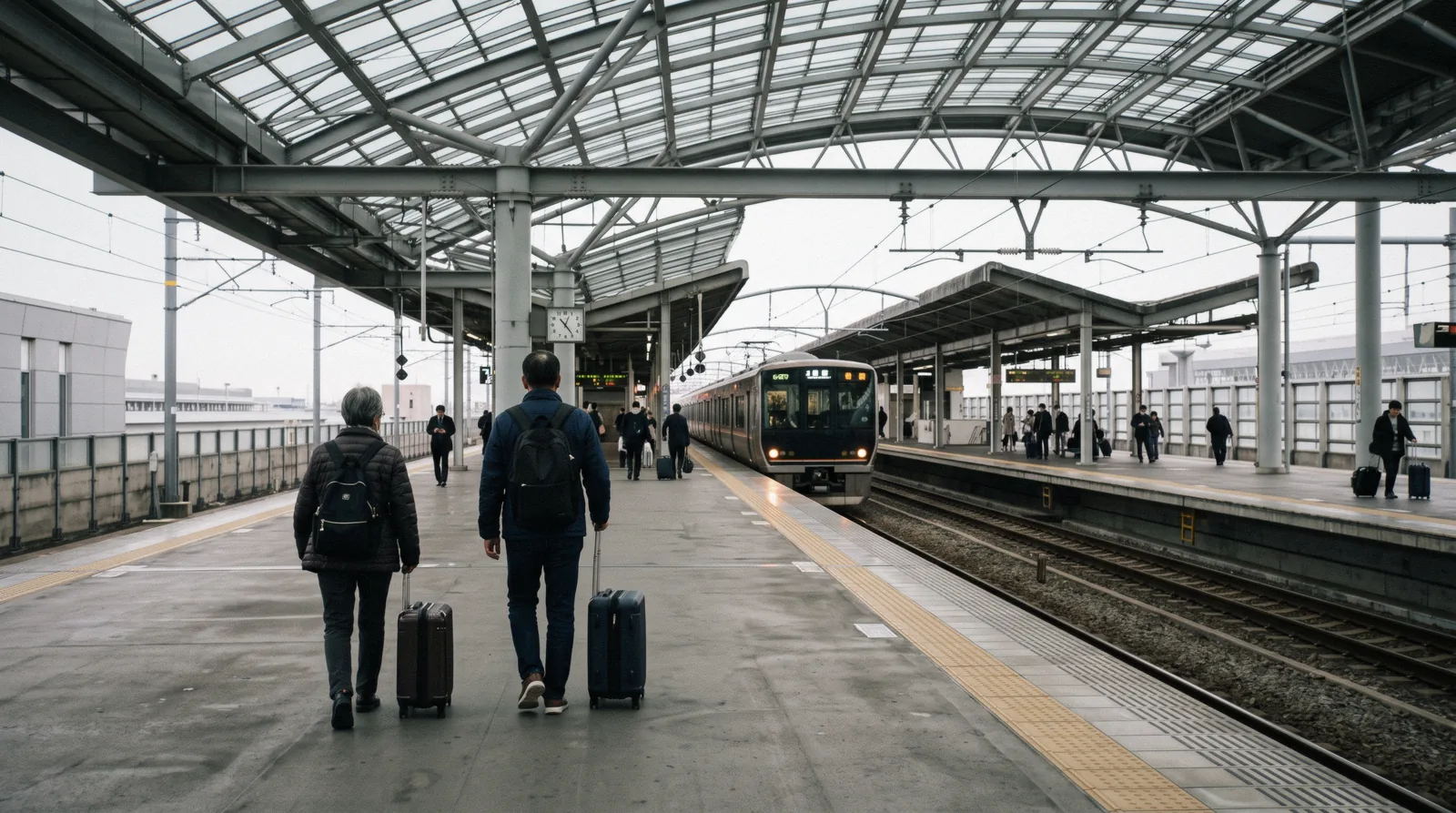
Kansai Airport to Osaka
Kansai Airport to Osaka is a twenty-minute decision that people spend a week worrying about, and the reason is that the two railways serving the airport land in different halves of the city. Nankai runs to Namba, in the south, under the neon; JR runs through Tennoji to Osaka Station and Shin-Osaka, in the north. Whichever half your hotel is in decides the route, and the fare gap between the fastest and the cheapest is smaller than almost every guide implies. This page prices every published route — the ordinary Nankai train, the Rapi:t and its discounted through-ticket, the JR HARUKA visitor fare, the two limousine buses and a booked car — and says plainly which we would take, and what nobody publishes. Yen figures are the operators' own; dollar glosses are approximations at ¥1,000 ≈ $6.27 (European Central Bank reference rate via frankfurter.dev). Once you are in town, getting around Osaka takes over, the whole trip is priced on the Osaka costs page, and the city starts on the things to do in Osaka homepage.
Quick answer Every route into the city, with its fare and time — in five lines
Nankai's Airport Express reaches Namba in about 44 minutes at the ordinary fare, with no surcharge and no reservation. The Rapi:t limited express does the same trip in about 34 minutes for $4.39 more in a regular seat, or $9.78 all in on the discounted Kanku Toku-wari through-ticket (¥700 / ¥1,560). For the northern half of the city, JR's HARUKA sells a discounted one-way ticket to foreign passport holders at $8.15 (¥1,300) to Tennoji and $11.29 (¥1,800) to Osaka or Shin-Osaka. The airport limousine bus is $8.78 (¥1,400) to Namba in 50 minutes and $11.29 (¥1,800) to Umeda in 60. All figures are the operators' own.
Key takeaways
- Staying in Minami — Namba, Dotonbori, Shinsaibashi? Take Nankai. Staying in Kita — Umeda, Osaka Station, Shin-Osaka? Take HARUKA with the discounted ticket, and the two are compared in full below
- The Rapi:t is a nicer train, not a much faster one: it buys about ten minutes over the Airport Express, and costs $1.88 (¥300) more if you buy on board and $0.94 (¥150) less if you buy ticketless
- Buy your ICOCA card at the airport before you leave the building — the visitor edition is sold only at the JR Ticket Office in Kansai-Airport Station
- Landing late, travelling with children or arriving as a group of four? A shared transfer or a private car removes the decision and the luggage handling together
- Two things nobody sells you: the city sightseeing pass does not work on this journey, and the airport's standard flat-fare taxi product was withdrawn on 31 May 2024
Every published route, priced
Fares and journey times are each operator's own published figures — Nankai, JR West and Kansai Airport Transportation Enterprise — read on in Q3 2026, with dollar glosses converted at ¥1,000 ≈ $6.27. The transfer prices are GetYourGuide's listings in USD on the same date.
| Route | Fare | Time | Lands at | Note |
|---|---|---|---|---|
| Nankai Airport Express (空港急行) | Ordinary fare, no surcharge | About 44 min | Namba | No reservation, no supplement; the default for the southern half of the city |
| Nankai Rapi:t, regular seat | Ordinary fare + $4.39 (¥700) (child ¥350) | From 34 min | Namba | ¥300 more bought on board, ¥150 less bought ticketless online |
| Nankai Rapi:t, Super Seat | Ordinary fare + $5.71 (¥910) (child ¥560) | From 34 min | Namba | Three-across seating with a 1,200 mm pitch; 54 seats on the train |
| Kanku Toku-wari through-ticket (fare + Rapi:t) | $9.78 regular seat, $10.91 Super Seat (¥1,560 / ¥1,740); child $4.89 (¥780) / $6.14 (¥980) | From 34 min | Namba, Shin-Imamiya, Tengachaya or Sakai | Valid two consecutive days from first use; sold at station windows and the pink and grey machines |
| JR HARUKA, discounted one-way | $8.15 to Tennoji, $11.29 to Osaka or Shin-Osaka (¥1,300 / ¥1,800); child exactly half | Limited express | Tennoji, Osaka, Shin-Osaka | Foreign passport with Temporary Visitor status; getting off at an intermediate station voids it |
| Airport limousine bus to Namba (OCAT) | $8.78 adult, $4.39 child (¥1,400 / ¥700); 14-day return $15.68 (¥2,500) | 50 min from Terminal 1 | OCAT, Namba | First come, first served; bags in the hold, no transfers |
| Airport limousine bus to Osaka Station / Umeda | $11.29 adult, $5.64 child (¥1,800 / ¥900); 14-day return $20.70 (¥3,300) | 60 min | Hankyu Sanban-gai, Umeda | A one-day return combination is also listed at ¥2,700 |
| Shared airport transfer | From $15.98 | Door to door | Your address | Booked ahead against your flight; the cheapest way to arrive without carrying bags |
| Private one-way transfer | From $64.79 | Door to door | Your address | A car to yourselves; the answer for four people, small children or a late landing |
The decision in one line: Nankai if you are sleeping south of the river, JR if you are sleeping north of it, and the bus if the thought of lifting a suitcase onto a train after a long-haul flight is the deciding factor. The fare spread between the cheapest train and the dearest bus is under ¥1,000 — about $6 — so this is a comfort decision dressed up as a money one.
Nankai to Namba: the ordinary train and the blue one
Two trains on the same track to the same terminus, one of which is ten minutes faster and looks like a spaceship.
The Airport Express is the workhorse: it leaves from the station attached to the terminal, needs no reservation and no supplement, and reaches Namba in about 44 minutes. For most arrivals it is the right train, and the money it saves is real rather than notional.
The Rapi:t is Nankai's limited express — deep blue, reserved, and quick enough to be worth it when you are tired. It cuts the run to a minimum of 34 minutes and adds ¥700 to the ordinary fare for a regular seat or ¥910 for a Super Seat, with children at ¥350 and ¥560. Two rules are worth knowing before you queue: buying the limited-express ticket on board costs ¥300 more, and buying it through Nankai's ticketless service costs ¥150 less. The gap between doing it properly and doing it badly is ¥450.
The simplest way to buy it is the Kanku Toku-wari ticket, which bundles the fare and the express supplement into one price: ¥1,560 for a regular seat, ¥1,740 for a Super Seat, half that for children. It is valid to Namba, Shin-Imamiya, Tengachaya or Sakai, stays valid for two consecutive days from first use, and is sold at those stations' windows and at the pink and grey ticket machines. Cash, most credit cards and prepaid IC cards are all accepted at the windows.
- Namba puts you inside Dotonbori, Shinsaibashi and Kuromon Market — walking distance, not another train
- Shin-Imamiya (about 34 minutes by Rapi:t, 39 by Airport Express) is the change for Shinsekai and the JR loop line
- Sakai is about 30 minutes out, Rinku Town about 10 — useful if your first night is near the airport
- For Koyasan, the Limited Express Koya runs from the airport side in about 1 hour 20 minutes
The one fare we could not read
Nankai publishes its ordinary fares only through a JavaScript fare search, and that search returns nothing to our requests — so we will not print a base Namba–Kansai Airport fare that we have not read. What the operator's own pages do give us is everything built on top of it: the Rapi:t supplements, the ¥1,560 through-ticket, the journey times, and a fare-revision notice from 1 October 2023 confirming that the airport-line surcharge and the ¥370 Rinku Town–Kansai Airport specific fare were both left unchanged by that revision. Every other guide quoting an exact Nankai base fare is quoting something we could not verify; if you want the figure before you fly, the machine at the airport will show it.
One related figure the operator does publish, and which tells you something useful about the airport line: when Nankai revised its fares on 1 October 2023 it left both the airport-line surcharge and the ¥370 specific fare between Rinku Town and Kansai Airport untouched. In other words the airport premium built into this journey has not moved in three years, whatever has happened to the exchange rate you are converting it at.
JR HARUKA, and the ticket you can only buy with a passport
The northern half of the city, and a discount that is unusually large for something official.
JR West's HARUKA limited express runs from the airport through Tennoji to Osaka and Shin-Osaka, and it sells a discounted one-way ticket to foreign passport holders that is a genuinely good deal: ¥1,300 to Tennoji, ¥1,800 to Osaka or Shin-Osaka, ¥2,200 to Kyoto, ¥2,000 to Kobe and ¥1,800 to Nara, with children at exactly half.
The conditions are strict and worth reading twice. You need a foreign passport and entry under Temporary Visitor status; you show the passport when you buy and again when you travel; and you may not buy more than one ticket per person for the same period. Buy it as an exchange order through an overseas agency and swap it in Japan within three months, or book directly on JR West's online reservation system with a credit card and collect it in Japan with the card and the passport.
The rule that voids tickets: you may not get off at an intermediate station. Break the journey at Tennoji on a ticket to Shin-Osaka and the ticket becomes invalid, not merely used. Refund fees start at ¥560 and rise with the timing and the seat reservation.
| Discounted HARUKA one-way | Adult | Child | What it is for |
|---|---|---|---|
| To Tennoji | $8.15 (¥1,300) | ¥650 | Abeno Harukas, the zoo, Shinsekai one stop further on |
| To Osaka / Shin-Osaka | $11.29 (¥1,800) | ¥900 | Umeda hotels, and the Shinkansen platform at Shin-Osaka |
| To Kyoto | $13.79 (¥2,200) | ¥1,100 | A first night in Kyoto before Osaka |
| To Kobe | $12.54 (¥2,000) | ¥1,000 | Sannomiya and the Kobe side of the bay |
| To Nara | $11.29 (¥1,800) | ¥900 | The deer park, with a change en route |
If your trip includes a Nara, Kobe or Himeji day on consecutive days, price the JR Kansai Area Pass instead: it includes a reserved HARUKA seat, which makes the arrival day the natural first day of it. We compare it against the city products on the getting-around page, because it is a Kansai decision rather than an airport one.
Which route, by where you are sleeping
The only question that decides this journey is which station is nearest your bed. Here it is answered directly.
Osaka's two halves have names worth learning before you book a hotel, because they are how every local gives directions. Minami — the south — is Namba, Dotonbori, Shinsaibashi and Nippombashi, and it belongs to Nankai. Kita — the north — is Umeda, Osaka Station and Shin-Osaka, and it belongs to JR. Tennoji sits between them on the JR side, with the Metro's Midosuji line stitching all three together.
The table below matches the districts this guide covers to the route that lands closest to them, using Nankai's own published journey times from the airport and JR West's discounted HARUKA fares. Where a Metro hop is still needed at the end, we say so — that hop costs ¥190 to ¥290 and is described on the getting-around page.
| Staying near | Take | Landing station | Then | Fare |
|---|---|---|---|---|
| Dotonbori, Shinsaibashi, Kuromon Market | Nankai Airport Express or Rapi:t | Namba | Walk, 5–15 minutes | Ordinary fare, or ¥1,560 all in on the Rapi:t through-ticket |
| Umeda and Osaka Station | JR HARUKA, or the limousine bus | Osaka Station | Walk, or one Metro stop | ¥1,800 by train; ¥1,800 by bus |
| Shin-Osaka, for an onward Shinkansen | JR HARUKA | Shin-Osaka | Walk to the Shinkansen concourse | ¥1,800 |
| Tsutenkaku and Shinsekai | Nankai to Shin-Imamiya | Shin-Imamiya (about 34 min by Rapi:t, 39 by Airport Express) | Walk, or one Metro stop to Ebisucho | Ordinary fare plus any Rapi:t supplement |
| Abeno Harukas and the Tennoji side | JR HARUKA | Tennoji | Walk from the station | ¥1,300 |
| Osaka Aquarium and the bay | Either railway | Namba or Osaka Station | Chuo line to Osakako | Route fare plus a ¥240–¥290 Metro hop |
| Universal Studios Japan | JR HARUKA | Osaka Station | JR loop line, change at Nishikujo | ¥1,800 plus a JR local fare |
Two additions to that table that are not about geography. If you are four people with luggage, the arithmetic tilts: four discounted HARUKA tickets to Umeda are ¥7,200, and a private car starts at $64.79 for the vehicle — at which point the car is the cheaper and vastly easier option, and it goes to the door rather than to a station. And if you are one person with a rucksack landing at midday, the ordinary Airport Express with no supplement at all is the right answer and always has been.
Booked transfers, if you would rather be met
Two ways to skip the whole page: a shared van booked against your flight, and a private car with the driver holding your name. Prices are GetYourGuide's own USD listings; the operator confirms the pick-up time and charges in your currency at checkout.
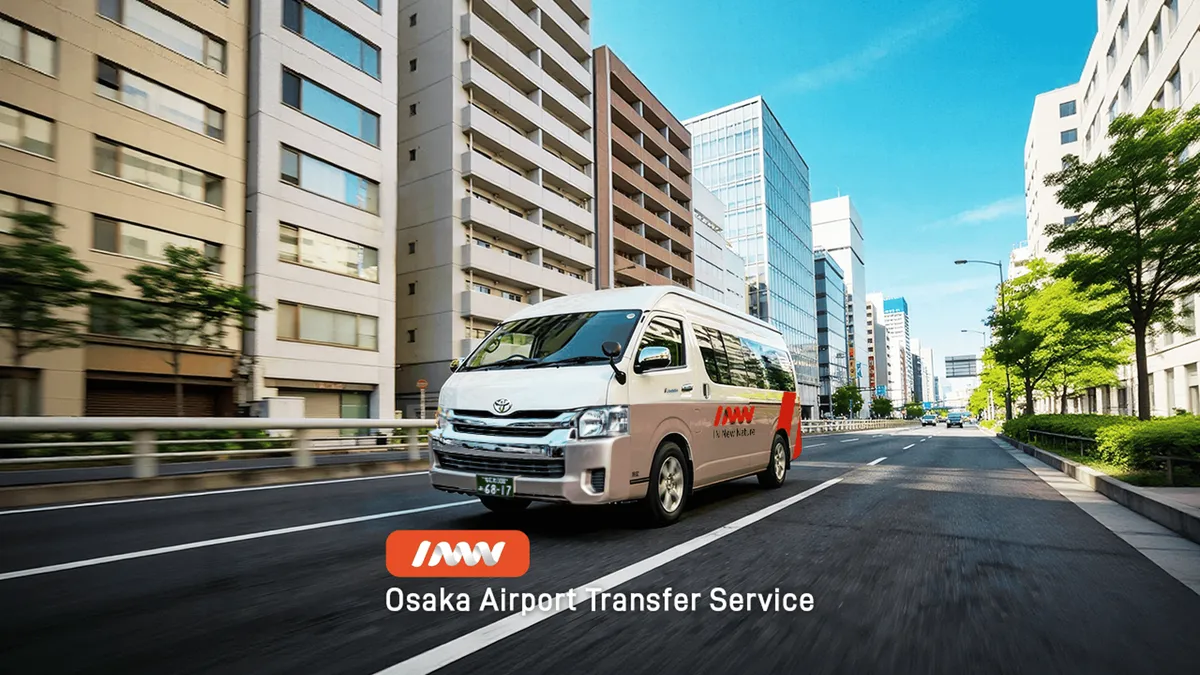 from $15.98
Osaka: Kansai Airport Shared Transfer Early Bird Reservation
A scheduled shared shuttle between Kansai Airport and 24 districts of the city, booked ahead and boarded with a QR code, tolls included. Cheaper than a taxi and closer to your door than the train, at the cost of a fixed departure time.
Check Availability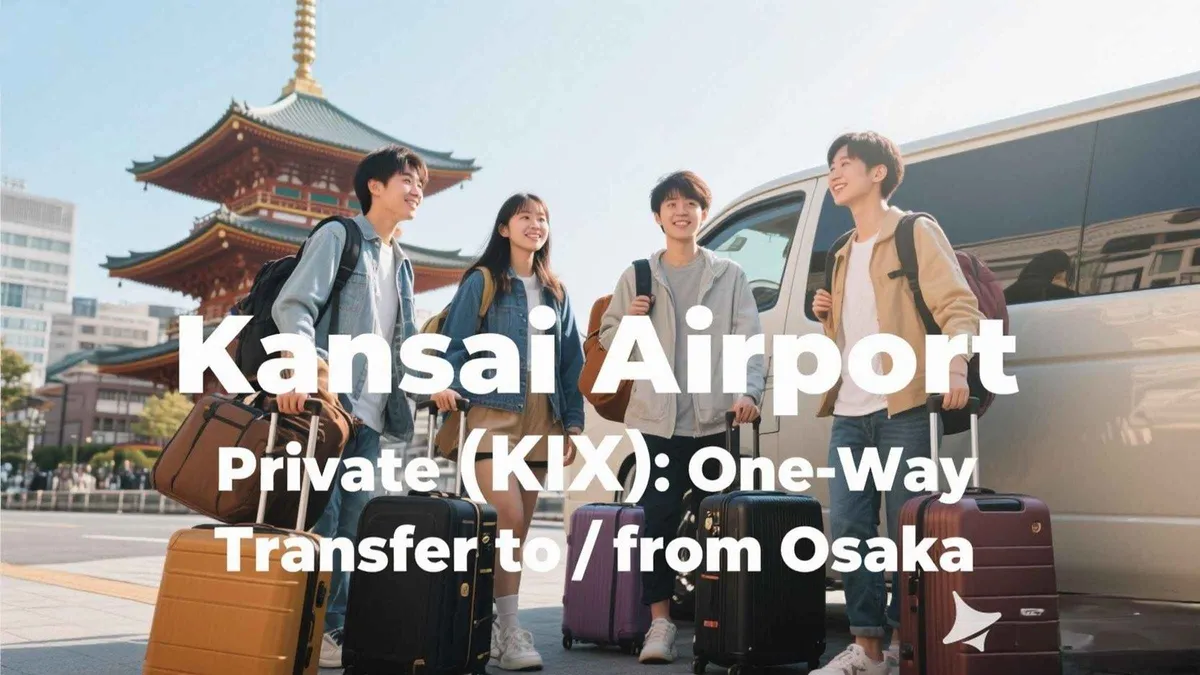 from $64.79
Kansai Airport (KIX): Private One-Way Transfer to/from Osaka
A private one-way car to or from Kansai Airport, with 60 minutes of free waiting on arrivals and flight delays covered up to two hours. The case for it is luggage and a late landing rather than speed — the train takes about as long.
Check AvailabilityPrices, ratings and details are the platform's own. Dollar figures are the listed prices. The platform bills in your account's currency.
The limousine bus, taxis and what the airport will not tell us
The route with no stairs at all, and the two prices no official source publishes.
The airport limousine bus is the choice of people who do not want to touch their luggage again until the hotel. Bags go in the hold, there are no transfers and no platform, and the seats recline. To OCAT in Namba it is ¥1,400 adult and ¥700 child, 50 minutes from Terminal 1 in ordinary traffic; a return ticket valid 14 consecutive days is ¥2,500. To Osaka Station, arriving at Hankyu Sanban-gai in Umeda, it is ¥1,800 adult and ¥900 child, 60 minutes, with a 14-day return at ¥3,300 and a one-day combination ticket listed at ¥2,700.
Neither route takes reservations: both are first come, first served, and both run from early morning to late at night — the operator's Namba timetable starts at 06:10 in each direction, and the Osaka Station page lists departures from before 05:00. The shuttle between Terminal 1 and Terminal 2 takes about 11 minutes, which is worth adding to your own arithmetic if you fly into T2.
The honest caveat: the bus is the route most exposed to traffic. Fifty minutes is the published figure, not a guarantee, and Osaka's ring roads are unforgiving at the end of the working day. On a tight connection, take a train.
Taxis, ride-hailing and Itami
Kansai Airport withdrew its standard Airport Taxi fares on 31 May 2024. What remains is chartered flat-rate operators quoting per booking, plus Uber with its own counter at the airport. That single fact is all we could extract from the airport's own domain: kansai-airport.or.jp answers 403 to every request we make, as does osaka-airport.co.jp, and the bus operator okkbus.co.jp serves a certificate for a different host and drops plain requests. So a fixed taxi price for this journey is not something we, or anyone quoting an official source, can give you.
If you land at Itami — Osaka International Airport (ITM), the domestic airport, the answer is the Osaka Monorail, and it is cheap: ¥200 to Hotarugaike (adult; child ¥100), where you change for the Hankyu Takarazuka line, or ¥340 to Senri-Chuo (child ¥170), where you change for Kita-Osaka Kyuko and run straight down the Midosuji line into Umeda and Namba. Those two figures come from the monorail's own fare search; when we went back to re-read them the fares had moved behind an interactive search that returns nothing to us, so treat them as a snapshot. Itami's limousine bus fares we could not verify at all — the operator and the airport both refuse our requests — so we print no figure for them rather than repeat one.
One product that specifically does not help here: the city sightseeing pass covers the Metro, the city buses and the private lines inside Osaka City, and it is not valid to or from Kansai Airport. Its Itami variant does add the monorail from Osaka Airport, which is the one case where a pass touches an airport at all — the two versions are compared on its own page.
Arriving with a wheelchair, a pushchair or a lot of luggage
Two things make this easier in Osaka than the planning suggests. The airport gained a Universal Tour Desk on 12 May 2025, and the tourism bureau runs an accessible-tourism site with a barrier-free facility search and five accessible model itineraries — one of which is built around Osaka Port and the theme park, and one around Namba and Shinsekai. Its English edition is machine-translated and says so, so use it for figures and facilities rather than for phrasing.
On the trains, every one of the 134 Osaka Metro and New Tram stations has a lift, a step-free route from street to platform and platform screen doors, and the way to ask for help is to tell the staff at the ticket gate on the day — there is no advance booking. That applies from your first Metro transfer onwards; the detail is on the getting-around page.
The first hour in the city
Four things to do before you have properly arrived, in the order they save the most trouble.
- Buy the IC card in the arrivals hall. An ICOCA is ¥2,000 including a ¥500 deposit, cash only, and the visitor edition is sold only at the JR Ticket Office in Kansai-Airport Station. It then works on every train and bus in the region — the full card rules are here.
- Decide the half of the city first, the train second. The route follows the hotel, not the other way round: Namba for Nankai, Umeda and Shin-Osaka for HARUKA. Nothing else about this decision matters as much.
- Do not plan a timed ticket for the arrival afternoon. Tsutenkaku now needs a timed reservation for every ticket and teamLab sells date-and-time entry — book those for a day you are certain to be on time.
- Keep some cash. The IC card purchase itself needs it, and so do plenty of the small counters. Cards are otherwise accepted almost everywhere a visitor goes.
Where to put the bags on the day you land
Check-in is usually 15:00 and your flight rarely cooperates, so the first afternoon is spent either carrying a suitcase or not.
The gap between landing and a hotel room is the part of an arrival day nobody plans, and in Osaka it has three published answers: the automated lockers on the Metro, the staffed counters at the big stations, and a same-day delivery service that takes the bag off your hands entirely.
Start with the honest gap in the record. Neither JR West nor Nankai publishes a coin-locker tariff. JR West's own Osaka Station page says only "coin lockers: yes"; Osaka Station City adds attendant hours of 09:00 to 21:30 and a real-time vacancy checker, and no price; Nankai's locker pages serve nothing readable at all. So every locker price below is a Metro smart-locker or staffed-counter figure, because those are the only ones anybody publishes.
The smart lockers matter most for an arrival: under one hour is free, which covers the classic manoeuvre of dropping bags while you check whether the room is ready. They sit at Hommachi on the Chuo line and Nipponbashi on the Sennichimae line — both a few minutes from Namba, and both on the route in from the airport.
| Where | Hours | Price | Note |
|---|---|---|---|
| Metro smart lockers, small | 24 h, app-operated | Free under 1 h · ¥300 per 3 h · ¥900 for 24 h | 330 × 645 × 241 mm internal |
| Metro smart lockers, medium | 24 h | ¥400 per 3 h · ¥1,200 for 24 h | Delivery to a city hotel ¥2,300 |
| Metro smart lockers, large | 24 h | ¥600 per 3 h · ¥1,800 for 24 h | Delivery to a city hotel ¥2,800 |
| n·e·s·t Namba, inside Nankai Namba | 09:00–21:00 | ¥800 per item per day, up to 14 days | English-speaking staff; the counter nearest the Nankai arrival |
| Crosta Osaka, JR Osaka Station | 09:00–20:00, year-round | ¥1,000 per piece · ¥2,000 to deliver | Card only — no cash |
| Crosta Shin-Osaka | 09:00–20:00 | ¥1,000 per piece · ¥2,000 same-day hotel carry | Cash or card |
Two dates, and a 14:00 deadline
Two dates and one deadline to hold on to. The Shin-Osaka Luggage Station closes for good on Monday 28 September 2026, so a page or a blog recommending it after that is recommending a shutter. The counter counts above come from the tourism bureau's own hands-free travel pages. And the hotel delivery services need the bag by 14:00 to reach one of the 153 Osaka city hotels they serve that day — miss that and you are carrying it after all.
Our own preference on an arrival day is unglamorous: take the bags to the hotel first even if the room is not ready. Every hotel here will hold them at the desk for nothing, the desk is on your way in from either station, and the free hour in a Metro locker is better spent later in the trip, on a checkout morning with an evening flight.
Going back out, and the timing that catches people
The return leg is a different problem: on the way in you are tired, on the way out you are watching a clock.
Three things change on the way back to the airport. The first is traffic: the limousine bus's 50 and 60 minutes are ordinary-conditions figures, and the roads out to the bay do not behave in the late afternoon. Departing, we take a train and keep the bus for arrivals.
The second is which terminal. The shuttle between Terminal 1 and Terminal 2 takes about 11 minutes on the operator's own timing, and low-cost carriers use Terminal 2 — so a T2 departure needs that quarter of an hour added to everything below.
The third is ticket validity. The Kanku Toku-wari through-ticket is valid for two consecutive days from first use, which means the one you used on arrival is not the one that takes you home unless you are leaving the next day; buy a second. The discounted HARUKA ticket has the harder rule — getting off at an intermediate station voids it entirely — so if you were planning to leave your bags at Tennoji on the way out, buy to Tennoji and buy again from there.
- Neither limousine bus takes reservations in either direction — first come, first served, and a full bus means waiting for the next one
- The operator's Namba timetable runs from 06:10 in both directions; the Osaka Station page lists departures from before 05:00
- Rapi:t tickets bought on board cost ¥300 more — buy at the machine before you go through the gate, or ticketless for ¥150 less
- Refunds on the discounted HARUKA ticket start at ¥560 and rise with the timing and the seat reservation
- An unused ICOCA can be refunded for its ¥500 deposit and remaining balance at a JR West office — but not if you moved it into Apple Wallet, which is a one-way door
For an early departure, the calculation people get wrong is not the train — it is the walk. Namba and Umeda are both large, layered stations where the platform can be a genuine ten minutes from the street, and Umeda is four stations wearing one name. Add fifteen minutes to whatever the app tells you, and use the first video below if you want to see what that actually looks like before you do it with a suitcase.
Where to go next
The three pages an arrival leads straight into.
Getting around Osaka
Metro zones, the day card and its exclusions, the IC card rules and the pass that was renamed in April 2026.
TransportWhat Osaka costs
The whole trip priced from published figures, including the lodging tax that changed in September 2025.
The budgetThings to do in Osaka
What to point the first full day at, grouped so the transport decisions above make sense in order.
The listKansai Airport to Osaka: the questions
How can I get from Kansai Airport to Osaka?
Five published ways. Nankai's Airport Express to Namba in about 44 minutes at the ordinary fare; the Rapi:t limited express on the same line from 34 minutes for ¥700 more; JR's HARUKA to Tennoji, Osaka and Shin-Osaka on a discounted visitor ticket; the limousine bus to Namba or Umeda; or a booked transfer to the door. The full table is above.
How much does it cost to get from KIX to Osaka?
Between about $8.15 and $11.29 for almost every route (¥1,300 and ¥1,800). The discounted HARUKA is ¥1,300 to Tennoji and ¥1,800 to Osaka or Shin-Osaka; the Kanku Toku-wari Rapi:t ticket is ¥1,560; the bus is ¥1,400 to Namba and ¥1,800 to Umeda. The ordinary Nankai Airport Express is cheaper still, at the plain fare with no surcharge.
Which is better, Nankai or JR, from Kansai Airport?
It depends only on where you sleep. Nankai lands at Namba, in the middle of Minami — Dotonbori and Shinsaibashi are a walk away. JR's HARUKA lands at Tennoji, Osaka Station and Shin-Osaka, which is the northern half of the city and the Shinkansen platform. Taking the wrong one costs you a cross-city Metro ride with luggage.
Is the Rapi:t worth the extra fare?
It buys about ten minutes and a reserved seat for ¥700 in a regular seat or ¥910 in a Super Seat. On a late-evening landing with luggage, most people find that easy money; in the middle of the day the Airport Express is the same track and the same terminus. Buy it ticketless for ¥150 less, and never on board, which costs ¥300 more.
What is the best way to get to Kansai Airport from Osaka?
The same routes, backwards, with one change of emphasis: leaving, the risk is traffic rather than comfort, so we would take a train. The Kanku Toku-wari ticket is valid for two consecutive days from first use, so a ticket bought for the arrival is not the same ticket as the one home. Allow for the 11-minute shuttle if you fly out of Terminal 2.
How much is a taxi or an Uber from Kansai Airport to Osaka?
Nobody official publishes a figure any more. The airport's standard Airport Taxi fares ended on 31 May 2024, leaving chartered operators who quote per booking and Uber with its own counter; the airport's own site answers 403 to our requests, so we will not invent a price. A booked private transfer has a listed price before you fly, which is the honest alternative.
How do I get from Itami airport into the city?
By Osaka Monorail: ¥200 to Hotarugaike for the Hankyu Takarazuka line, or ¥340 to Senri-Chuo for the Midosuji line into Umeda and Namba, with children at half. Itami's limousine bus fares are published only on sites that refuse our requests, so we quote none. Itami is domestic-only — international arrivals land at Kansai.
Can a city sightseeing pass cover the airport journey?
No. The city pass covers the Metro, the city buses and the private railway sections inside Osaka City, and it is explicitly not valid to or from Kansai Airport in either direction. Its Itami version does include the Osaka Monorail from Osaka Airport. Buy your airport ticket separately, whichever pass you are holding.
On film: the trains, the platforms and the walk to them
Three videos whose ids we verified against YouTube's own record and thumbnail, so none of these is a dead player. They load only when you press play.
How to EASILY Get From Kansai Airport to Namba, Osaka by Train
The Nankai route this page recommends for the southern half of the city, filmed end to end.
Video: Travel with Tanya and SimonKansai International Airport to Osaka City Center by Train
Arrivals hall to platform at real pace — useful if you have never changed money and bought a ticket in the same ten minutes.
Video: Out of Bounds 界外How to get from Kansai Airport to Osaka & Kyoto
Both railways compared, including the HARUKA run north that this page prices.
Video: Japan GuideVideos load from YouTube only when you press play.
Prices, hours and terms are set by the venue or operator and confirmed at checkout.
We may earn a commission if you book through one of our links, at no extra cost to you. Full affiliate disclosure