 Osaka City Guide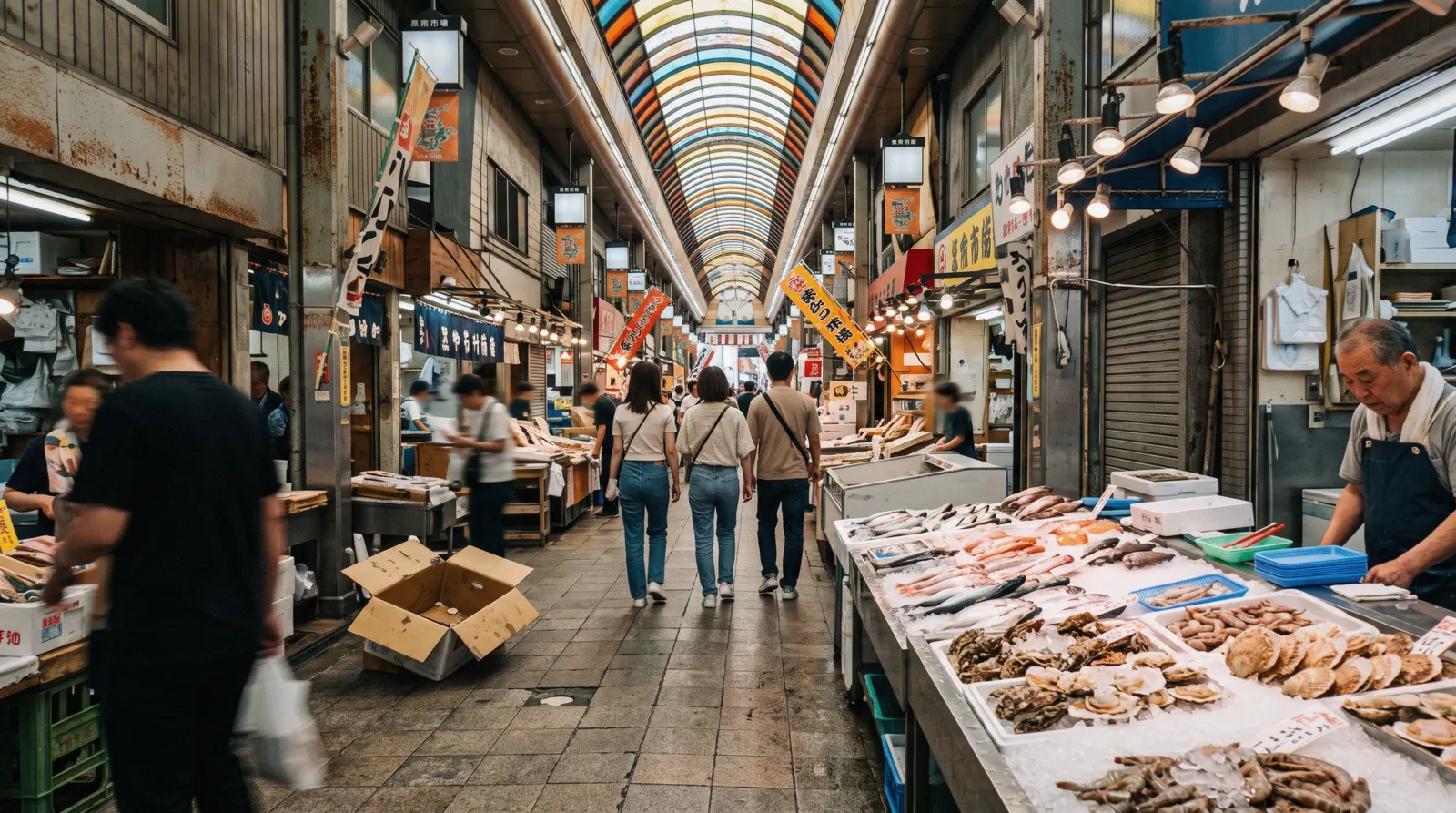
Kuromon Market
Kuromon Market — Kuromon Ichiba on its own signs — is 580 metres of covered arcade at Nippombashi, about 150 stalls of fish, wagyu, fruit, pickles and knives that supplied Osaka's restaurant kitchens long before it supplied anybody's Instagram. It is free to walk and there is nothing to book. What there also is not, and this is the finding that shapes the whole page, is a published opening time: neither the market's own association nor the city states when Kuromon opens, when it closes, which day it shuts, or whether you may eat in the aisles. Every precise figure you have read is somebody's estimate. For the rest of the city, see top places to visit in Osaka. Dollar figures are conversions at 1,000 yen to about $6.27 (European Central Bank reference rate); tour prices are GetYourGuide's own listings in dollars.
Quick answer Free, 580 metres, and why no hours exist
Kuromon Ichiba is free to walk and runs about 580 metres under an arcade roof at Nippombashi, with roughly 150 stalls. There is no market-wide opening time and no market-wide closed day, and that is not an omission on our part: the tourism bureau answers both questions with "Varies by location", and the market association's own website refused every request we sent it. Individual stalls open when they open, and the arcade is at its fullest through the late morning.
Key takeaways
- Nobody publishes an eating rule here. No Osaka district publishes a ban on eating while walking, and the one place such a rule would live — the association's site — is behind a bot wall. In practice the stalls that sell hot food give you a place to stand and a bin; use them
- The one street rule that is published and enforced: street smoking has been a 1,000-yen fine (about $6.27) across the whole city since 27 January 2025, heated tobacco included. More on the city rules
- Late morning is the market working. Come at 09:00 and half the shutters are down; come at 14:00 in high season and you are shuffling behind a queue that has already bought the good scallops
- If you want the market explained rather than guessed at, the two-hour wagyu and street-food walk puts most of its time inside the arcade; the $17.48 walking tour is the cheap way to see it with a licensed guide
Key facts
Opening hours
| The arcade — a public covered street with no gate | Open |
|---|---|
| Stalls — the tourism bureau publishes only "Varies by location" | Not stated–Not stated |
| Market-wide opening and closing time | Not published by anyone–Not published by anyone |
Closed "Varies by location", per the tourism bureau. No market-wide closed day is published, and the association's own site could not be read
Admission
- Adult
- Free to walk
- Reduced
- Not applicable — nothing here is ticketed
- Free
- The whole arcade; you pay only for what you eat, and cash is still the safer assumption at the older counters
Planning it
- Time needed
- Not stated by anyone; our routing: 45 minutes to walk the arcade end to end with three or four stops
- Book ahead
- Optional — walk-up usually fine
- Address
- 2-4-1 Nippombashi, Chuo-ku, Osaka 542-0073
Nothing in Kuromon is ticketed, so the only decision is whether somebody walks the arcade with you and tells you which of five identical-looking counters is the one worth queueing at. Market details are the tourism bureau's own, read on in Q3 2026; tour prices are GetYourGuide's listings on the same date.
The arcade is free to walk and cash is still the safer assumption, so the only question is whether a guide picks the counters for you — from $17.48 for a walk with some food to $51.13 for a full meal of twelve dishes.
| Option | Price | What it is | Cancel | Book |
|---|---|---|---|---|
| Walk it yourselfAnyone happy to point at what looks good; bring cash for the older counters | Free; you pay for what you eat | About 580 metres of arcade, roughly 150 stalls, no gate and no ticket office; cash preferred at the older counters | Not applicable | Official site |
| Dotonbori, Hozen-ji and Kuromon walking tour, 2.5 hoursThe cheapest guided option, and the one that carries on to Den Den Town | Listed at $17.48 | A licensed guide from Shinsaibashi through the market and on to Den Den Town, with some food included; rated 4.9 from 23 reviews | Free up to 24 hours before | Check Availability |
| Wagyu and street-food tour, 2 hoursThe market-heaviest choice — wagyu, takoyaki, gyoza and a mochi dessert | Listed at $42.45 | The market-heaviest option — wagyu, takoyaki, gyoza, a mochi dessert and a matcha latte, finishing in Dotonbori | Free up to 24 hours before | Check Availability |
| Guided food tour, 12 dishes and 2 drinks, 2.5 hoursPeople who want the tour to replace a meal rather than sit beside one | Listed at $51.13 | The most-reviewed of the three at 4.8 from 231 reviews, and the one that feeds you a full meal rather than tastings | Free up to 24 hours before | Check Availability |
Our pick if you are choosing one: the wagyu and street-food walk, because most of its two hours are spent inside this arcade rather than passing through it, and because grilled wagyu skewers are the thing Kuromon does that no other Osaka street does as well. If the budget matters more than the depth, the $17.48 walk covers the same ground with a licensed guide and less food.
Kuromon Market Food Walks, Compared
Every card links to the operator's own page, where the calendar shows what is still open for your dates. Prices are the platform's listings in US dollars.
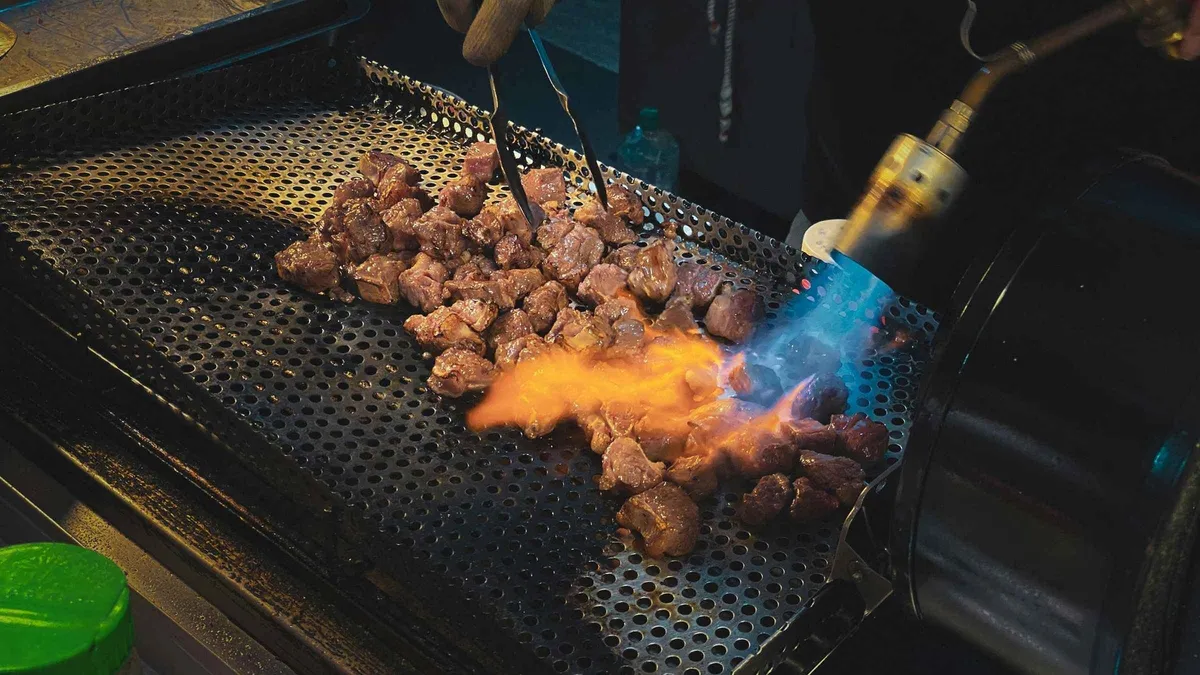 from $42.45
Osaka: Wagyu & Street Food Tour at Dotonbori, Kuromon, &more
Two hours weighted heavily towards Kuromon Market — 105 minutes of the itinerary sits there — with wagyu, takoyaki, gyoza and a matcha latte, finishing in Dotonbori. Six reviews so far, all five stars.
Check Availability from $17.48
Osaka Walking Tour: Dotonbori, Kuromon Market & Street Food
Two and a half hours from Shinsaibashi through Hozen-ji, Kuromon Market and Den Den Town with a licensed guide and some food included. Cheap for a guided walk, but only 23 people have rated it so far.
Check Availability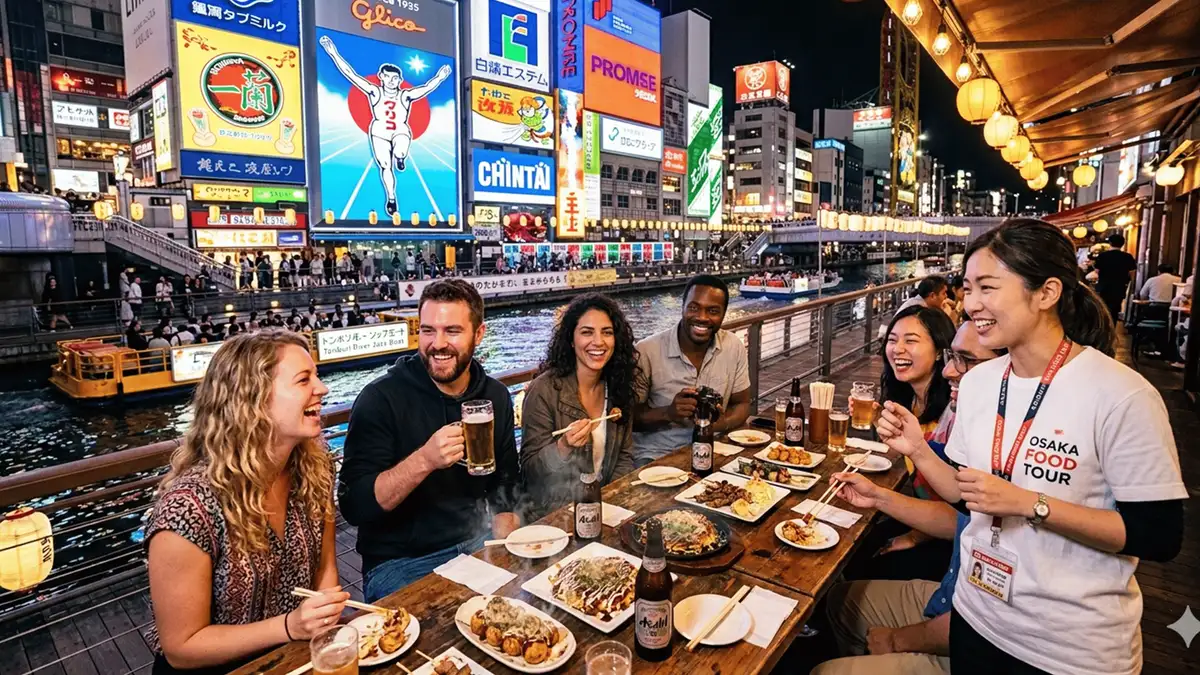 from $51.13
Osaka: Guided Food Tour with 12 Dishes and 2 drinks
Twelve dishes and two drinks in two and a half hours, taking in sake bars locals use and a street stall listed in the Michelin guide. Well rated, and among the cheaper options per dish in this group.
Check Availability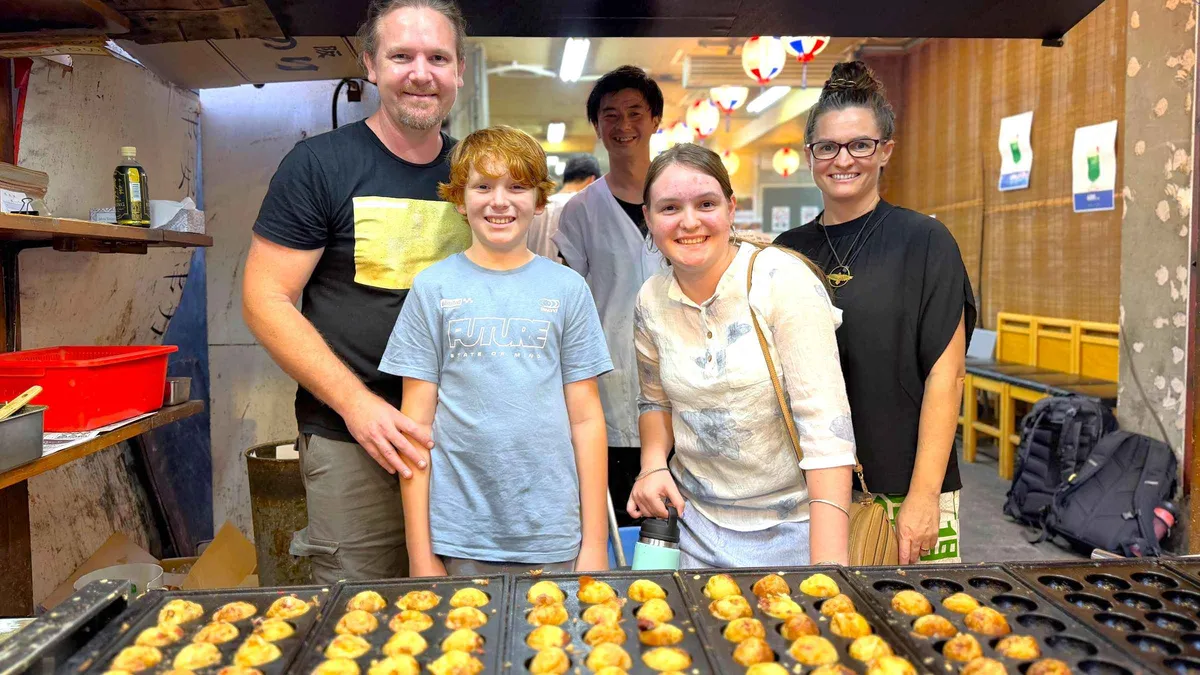 from $53.37
Osaka: Dotonbori Street Food Tour with Tastings
Two hours of street food along Dotonbori with a temple stop and the Glico sign, guide included. The listing never says how many tastings you get, which the 12- and 15-dish tours in this group do.
Check Availability from $74.91
Osaka, Dotonbori: Backstreet Food Tour with Local Guide
Three hours off the main strip in a group of no more than eight: yakitori, ochazuke, oden and a fourth stop the guide picks. Drinks are not included, which is the difference from the cheaper 15-dish evening tours.
Check AvailabilityPrices, ratings and details are the platform's own. Dollar figures are the listed prices. The platform bills in your account's currency.
The Hours Question, and Why It Has No Answer
More people search for Kuromon Market's opening hours than for what to eat in it. There is no published answer, and it is worth knowing exactly how that dead end is built.
There are two bodies that could publish the market's hours. The Osaka Convention and Tourism Bureau runs a spot page for Kuromon, and against both hours and closed days it prints the same phrase: "Varies by location". The market's own association runs kuromon.com, which is the site every search result points at and the one that would carry a market-wide time if such a thing existed. That site is behind a bot challenge. It returned a 403 to an automated request and to a plain browser request, and the same wall was hit from two other approaches on the same day.
So when a guide tells you Kuromon is open 09:00 to 18:00 and closed on Sundays, it is repeating an average somebody once estimated. Some stalls are trading before 08:00 because they always were fish wholesalers; some do not raise a shutter until 10:00; some close on Sunday, some close on Wednesday, and the restaurant counters at the southern end keep evening hours the fishmongers never did.
The practical version, which we can stand behind because it is a description rather than a claim: the arcade behaves like a working market in the late morning and like a food court in the afternoon. If you need a specific stall, the only reliable source is that stall's own page.
| Question | What is published | Who publishes it |
|---|---|---|
| Market-wide opening hours | Nothing — "Varies by location" | Tourism bureau; the association's site is unreachable |
| Closed days | Nothing — "Varies by location" | Tourism bureau |
| Eating in the aisles | No rule published, here or in any other Osaka district | Nobody |
| Length of the arcade | About 580 metres | Tourism bureau |
| Number of stalls | About 150 — though the bureau's own Experience page says almost 170 | Tourism bureau, disagreeing with itself |
| Address and phone | 2-4-1 Nippombashi, Chuo-ku, Osaka 542-0073; 06-6631-0007 | Tourism bureau |
| Prices for anything sold here | Not published by any public body | Nobody |
We will keep retrying the association's site. If it ever answers, its hours and its own manners rules replace everything in this section, and the date on this page will change with it.
From Enmyoji Market to Now: 1822, Two Fires and a Rebuild
Kuromon is older than almost anything else you will walk through in Minami, and it has burned down twice.
The tourism bureau's account starts in 1822 and 1823, when merchants began selling fish from Sakai and Kishu beside Enmyoji temple, on this ground. The market took the temple's name first — Enmyoji Market — and the black gate that eventually gave it the name Kuromon, black gate market, belonged to that temple.
It burned in the Great Namba Fire of 1912 and was rebuilt. It burned again in the air raids of the Second World War and was rebuilt again. What survived both times was the trade rather than the fabric: this was the wholesale counter for professional kitchens in southern Osaka, which is why the stalls are still built around fish, and why the knife shops and the pickle counters sit between them rather than being souvenir stands added later.
That history is also the honest answer to the tourist-trap question. Kuromon spent two centuries selling to chefs and roughly the last fifteen years selling to visitors, and both trades are in the arcade at once. The counter grilling scallops for a queue of phones and the counter selling a box of hamo to a restaurant buyer are four metres apart.
What Is Worth Stopping For, and Why No Stall Is Named
This page names no shop in the arcade, and the reason is a rule this site applies everywhere.
A food business is named here only when a citable list stands behind it: the MICHELIN Guide, a body such as Slow Food, or the venue's own published information. For Osaka the list that covers this kind of eating is the MICHELIN Guide Kyoto Osaka 2026 Bib Gourmand selection — 67 addresses in the city and its surroundings, printed with name, address, cuisine and a price band, and with no opening hours and no closed day for any of them. Not one of those 67 is a Kuromon stall, and the selection contains no takoyaki venue and no okonomiyaki venue anywhere in Osaka.
So what follows is by category rather than by name, and the categories are the ones the market has actually been trading in since it sold to kitchens rather than to visitors. Prices are deliberately absent: no public body publishes a tariff for anything in this arcade, and a range invented from memory would be the exact sort of figure this page exists to argue against.
- Grilled scallops and oysters — opened at the counter, cooked in front of you, the single most photographed thing in the arcade and genuinely good
- Wagyu skewers and thin-sliced grill — several counters do this and it is the market's strongest street-food card; the wagyu walk is built around it
- Uni, otoro and sashimi trays — the fish trade is the reason the market exists; the trays are cut to order and the older counters expect cash
- Fruit — melon, strawberries, grapes cut into cups; expensive by any standard, and Japanese gift fruit is a category rather than a snack
- Pickles, dried goods, kombu and knives — the shops the professional buyers still come for, and the ones with nothing to photograph
The practical warnings that do hold: many counters remain cash-first, portions are small and priced per piece rather than per plate so a walk through the arcade adds up faster than it looks, and the stalls doing the highest volume are not necessarily the best — they are the ones nearest the Nippombashi entrance. Walk the full 580 metres before you buy anything. The Osaka food page covers the named venues that a citable list does stand behind, and Dotonbori covers the street-food half of Minami.
Kuromon Against Osaka's Other Walking Food Streets
Four covered or semi-covered streets in central Osaka that get recommended interchangeably, set out with the only figures a public body actually publishes for each. Every dimension below comes from the Osaka Convention and Tourism Bureau's own spot pages.
| Street | Published size | What it sells | Published hours |
|---|---|---|---|
| Kuromon Ichiba | About 580 m, roughly 150 stalls | Fish, wagyu, fruit, pickles, knives; eat-at-the-counter street food layered on top | "Varies by location" |
| Dotonbori | No length published | Restaurants and the illuminated signs; an evening street, not a market | "Varies by store" |
| Tenjinbashisuji | About 2.6 km, about 800 shops | A working local shopping street — the length claim has no public certifier | "Business hours vary by shop" |
| Shinsaibashi-suji | About 580 m, roofed | Clothes and retail rather than food; about 60,000 people on a weekday | "Business hours vary by individual store" |
All four pages were read, and every one of them answers the hours question the same way. That pattern in the last column is the useful part: none of these streets is an attraction with an operator, so none of them has an opening time — which is why a site that prints one for any of them has made it up.
When to Go, How Long It Takes, and the Tourist-Trap Question
Two of the four questions Google shows for this market are about timing and about whether it is a trap. Both have practical answers.
Go in the late morning. Before about 09:00 a good share of the arcade is still shuttered and what is open is trading with locals and restaurant buyers. From about 10:00 to 12:30 everything is open, the grills are lit, and the crowd is still one that you can walk through. From about 13:00 in high season the arcade slows to a shuffle, and the popular counters begin selling out of the things they cut fresh. By late afternoon the fish counters are packing up while the sit-down restaurants at the southern end are getting going.
Allow forty-five minutes to walk the 580 metres with three or four stops. That is our routing rather than a published figure, and it is the number people get wrong in both directions: an hour is plenty, and fifteen minutes is not enough to see past the first twenty stalls.
On the trap question, the honest answer has three parts. The prices are higher than a supermarket and lower than a restaurant, and nobody publishes them, so a complaint about being overcharged cannot be checked against any tariff. The stalls nearest the station charge most and queue longest. And the market genuinely still sells to professional kitchens — which is exactly why it is worth the walk, and why the counters at the far end are the better ones.
- Best window: about 10:00 to 12:30, every counter trading and the aisles still walkable
- Worst window: 13:00 to 15:00 in spring and autumn, when it is a queue rather than a market
- Walk the full length before buying — the last two hundred metres are cheaper and quieter
- Carry cash; several older counters still take nothing else
- Bins are at the stalls that sell hot food, not along the arcade — buy, stand, eat, hand the stick back
Getting to Kuromon Market
It is one of the easiest addresses in Osaka to reach: the arcade starts at a subway exit.
The market is at 2-4-1 Nippombashi, Chuo-ku, immediately outside Nippombashi station on the Osaka Metro Sennichimae line, which also carries the Sakaisuji line. From Namba it is one stop, or a nine-minute walk east along Sennichimae-dori. From Dotonbori it is the same nine minutes. The bureau lists a telephone number for the market, 06-6631-0007, which is the only contact point published anywhere.
Metro single fares run in five zone bands from 190 yen to 390 yen (about $1.19 to $2.45). If you are making four or more rides in a day, the Enjoy Eco Card at 820 yen on weekdays or 620 yen at weekends and public holidays (about $5.14 or $3.89) is already the cheaper option; getting around Osaka sets out the whole ladder. Nothing in the market is on the Osaka Amazing Pass free list, for the same reason nothing here has a ticket.
- Nippombashi station, Sennichimae and Sakaisuji lines — the arcade's northern end is at the exit
- One stop from Namba, or nine minutes on foot along Sennichimae-dori
- Nine minutes from Ebisubashi in Dotonbori, which makes a morning market and an evening canal a natural pair
- Step-free: the arcade is flat and covered end to end, though it is narrow when busy — the accessibility page has the wider picture
- Large suitcases are a genuine problem in a four-metre aisle; luggage storage covers the lockers
Kuromon Market Map: The Arcade and What Is Around It
The arcade runs roughly north to south from Sennichimae-dori, with Nippombashi station at its northern end. Everything else marked here is within ten minutes on foot.
Pin positions are from OpenStreetMap and Wikidata. The market pin is the arcade's mapped centre, not an entrance.
Next Stop From Kuromon Market
The market is a late-morning place, so what follows it matters. Walk times are our estimates from the mapped distances.
Hozenji Yokocho
Eighty metres of lantern-lit flagstone and a moss-covered statue, quiet in a way this arcade never is — and best at dusk, which is exactly when Kuromon is closing.
9 minutes westDotonbori
The canal, the signs and the boats. A morning here and an evening there is the standard Minami day, and the 20-minute river cruise is the only ticket in either.
9 minutes north-westWhere to eat in Osaka
The named MICHELIN Bib Gourmand venues, what takoyaki and okonomiyaki actually are, and why neither dish is attached to a shop name on this site.
The wider guideKuromon Market Questions
What are Kuromon Market's opening hours?
None are published. The tourism bureau answers both the hours and the closed-days question with "Varies by location", and the market association's own website was unreachable — a bot challenge that returned 403 to every request. Stalls set their own times; in practice the arcade behaves like a working market from about 10:00 to 12:30 and like a food court afterwards. Any site printing a market-wide time is printing a guess.
What is the best time to go to Kuromon Market?
Late morning, between about 10:00 and 12:30. Everything is open, the grills are running and you can still walk. From about 13:00 in high season the aisles slow to a shuffle and the counters that cut to order start running out. Before 09:00 a good share of the arcade is still shuttered.
Is Kuromon Market a tourist trap?
Partly, and the honest version has three parts. Nobody publishes prices for anything sold here, so an overcharging complaint cannot be checked against a tariff. The stalls nearest the Nippombashi entrance charge most and queue longest, and the last two hundred metres are quieter and better value. And the market genuinely still trades with professional kitchens — the fish, knife and pickle counters are not a set dressed for visitors. Walk the whole 580 metres before buying anything.
How long does it take to explore Kuromon Market?
Forty-five minutes end to end with three or four stops, which is our own routing rather than a published figure. An hour is comfortable. Fifteen minutes gets you the first twenty stalls and the wrong impression of the place.
Can you eat while walking in Kuromon Market?
No authority has published a rule either way, and we looked: no Osaka district publishes an eat-while-walking rule, and the one body that would — the market's own association — is behind a bot wall. What the stalls themselves do is provide a small standing area and a bin beside the till, which is the behaviour to copy: buy, step aside, eat there, hand the stick back. Street smoking, unlike eating, is explicitly banned city-wide at a 1,000-yen fine.
What should you eat at Kuromon Market?
Grilled scallops and oysters opened at the counter, wagyu skewers, sashimi and uni cut to order, and cut fruit — plus the pickle, kombu and knife shops that the restaurant buyers still come for. No stall is named on this page because no citable list backs one: the MICHELIN Bib Gourmand selection for Osaka contains no Kuromon address at all. The wagyu and street-food walk is the option that spends most of its time inside the arcade.
Is Kuromon Market free to enter?
Yes — it is a covered public street, not an attraction. There is no gate, no ticket office and nothing to book; you pay only for what you eat, and several older counters still prefer cash. The only paid options are the guided food walks, which start at $17.48.
Where Kuromon Fits in an Osaka Day
It is a late morning, and it sits one stop from everything else in Minami.
The sequence that works runs west across the day: Kuromon between 10:00 and noon while the arcade is at full trade, the covered arcades of Shinsaibashi through the flat afternoon, Hozenji Yokocho as the lanterns come on, and Dotonbori after dark for the signs and dinner. Three of those four are free, all of them are within a kilometre, and the only thing bookable in the whole day is a boat.
If the market is the thing you came for rather than a stop on the way, pair it with a morning at Osaka Castle — the keep opens at 09:00 and Nippombashi is a short ride back — and keep the afternoon light. Things to do in Osaka has the rest of the city, and the one-day itinerary places all of it in order.
Kuromon Market on Film: 580 Metres, Counter by Counter
Three walk-throughs we checked ourselves — each video id verified against YouTube's own record and its thumbnail, so none of these is a dead player. They show the aisle width and the queue lengths better than any description can.
OSAKA Kuromon Market Guide: Better than Nishiki Market?
A full walk of the arcade with the counters explained one by one.
Video: PiQtour JapanKuromon Ichiba Market Osaka: Must-Try Japanese Street Food with Prices
Filmed at the counters with the prices on screen — the closest thing to a published tariff that exists.
Video: Cathy HerrmannWhat to Eat at Kuromon Market Osaka
A shorter run focused on what is worth stopping for and what is not.
Video: JulezVideos load from YouTube only when you press play.
Prices, hours and terms are set by the venue or operator and confirmed at checkout.
We may earn a commission if you book through one of our links, at no extra cost to you. Full affiliate disclosure