 Osaka City Guide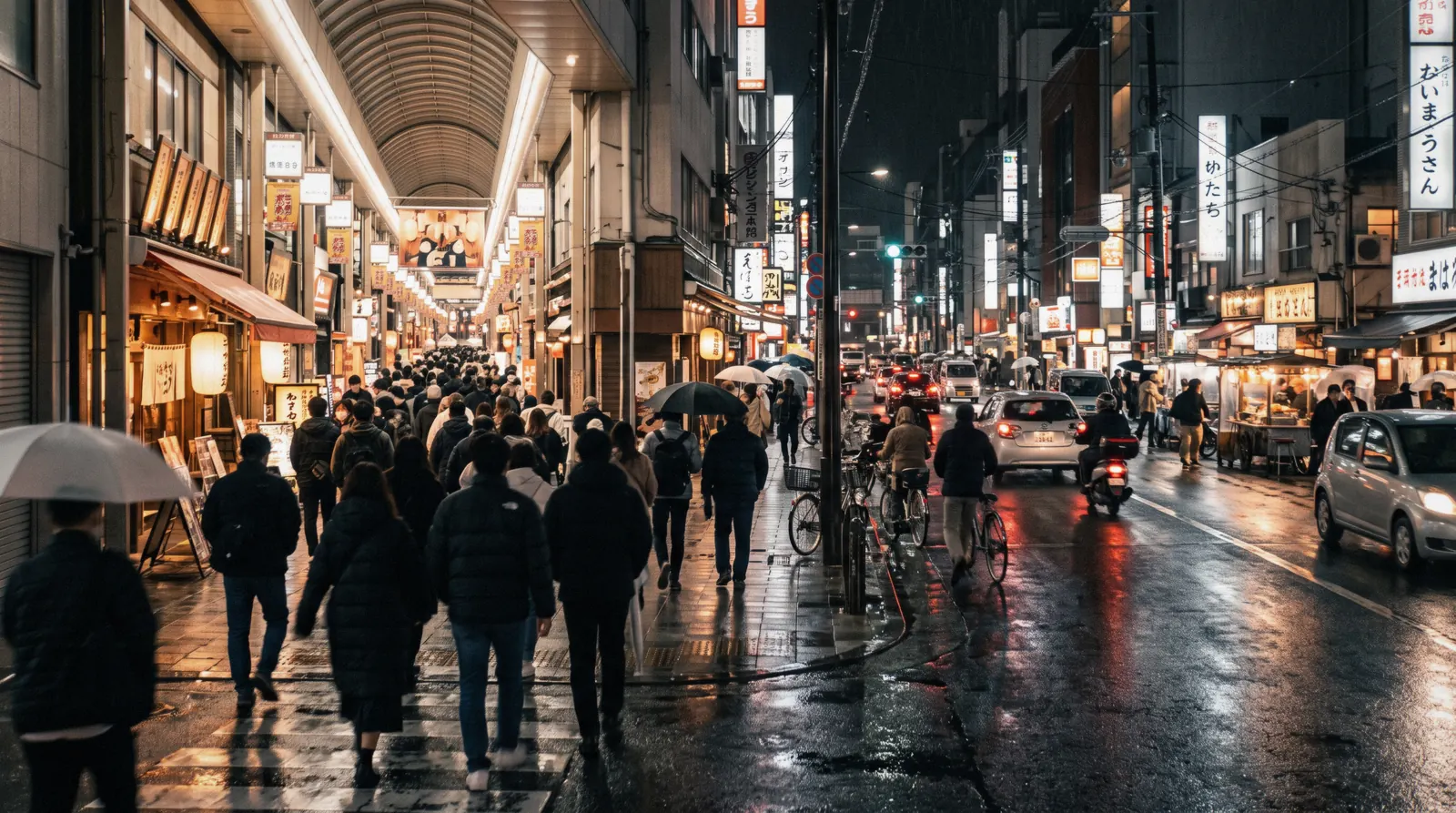
Namba
Namba, Osaka's southern centre, is where the airport train ends, the arcades start and the city eats. Minami — the south — is the name Osakans use for the whole half of the centre that runs from the canal down to the Nankai terminal, and Namba is its engine room: five railway companies, a bus terminal for the airport coaches, a kilometre of underground shopping and, at street level, more restaurants per block than anywhere else in Japan outside Tokyo. This page is the district and the transfers. The canal, the arcades, the market and the alley each have their own pages and their own keywords; the city as a whole is covered in things to do in Osaka.
Quick answer What Namba is, what is within ten minutes, and the airport train — in four lines
Namba is the southern half of central Osaka, in Chuo and Naniwa wards, and it is the district most visitors sleep in. It costs nothing to be in: the arcades, the canal and the alleys are public streets, and the paid attractions here belong to their own pages. Dollar figures below are converted at ¥1,000 ≈ $6.27, the European Central Bank reference rate.
Key takeaways
- This is the arrival district. Nankai's Airport Express reaches the Namba terminal from Kansai in about 44 minutes at base fare — no surcharge, no reservation — which is the cheapest fast route into Osaka from KIX
- Everything a first-timer comes for is inside a ten-minute walk of the gates: the canal, the covered arcade, the food market and the lantern alley
- The eating is the reason to be here after dark; a twelve-dish evening walk or the Kuromon and canal morning walk both start within the district
- Underground, Namba Walk trades 10:00–21:00 and its restaurants to 22:00, with one closed day a month — in September 2026 that is Wednesday the 16th
Everything within ten minutes of the Namba gates
The district is unusually compact, so this table is the page in miniature: what each part of it is, what it charges and how far it is from the Nankai concourse. Figures come from the Osaka Convention & Tourism Bureau's own spot pages and the venues' own sites, read on in Q3 2026; the walking times are ours.
| Where | What it is | Walk | Costs | Best hour |
|---|---|---|---|---|
| Dotonbori | The canal, the bridges and the signs; the river was cut in 1612 | 8 min | Free to walk | After 18:00, when the signage is lit |
| Shinsaibashi-suji | About 580 m of roofed arcade, 380 years old | 10 min | Free | Weekday morning; 120,000 people pass on a weekend day |
| Kuromon Ichiba | About 580 m of food market, roughly 150 stalls | 9 min | Free to enter | Late morning — nobody publishes market-wide hours |
| Hozenji Yokocho | Two stone lanes of small restaurants around a moss-covered statue | 7 min | Free | Dusk, before the tables fill |
| Amerikamura | 1970s second-hand clothing quarter in Nishi-Shinsaibashi | 12 min | Free | Weekend afternoon |
| Namba Yasaka Shrine | The lion-head hall; the shrine publishes neither hours nor a fee | 10 min | No fee published | Morning; phone 06-6641-1149 before a special visit |
Six places, six separate pages on this site, one twenty-minute radius. That density is the argument for basing yourself here rather than in the north: you can walk home from dinner instead of catching the last train.
Walks that start or spend their evening in Namba
No product in this catalogue is sold as a Namba tour, because operators sell the canal and the market by name instead. These six are the ones whose published itineraries genuinely sit inside this district: three city walks that use it as a spine, two food walks along the canal and through the market, and the boat that boards at Minatomachi Pier on its western edge. Prices are GetYourGuide's US-dollar listings.
 from $35.71
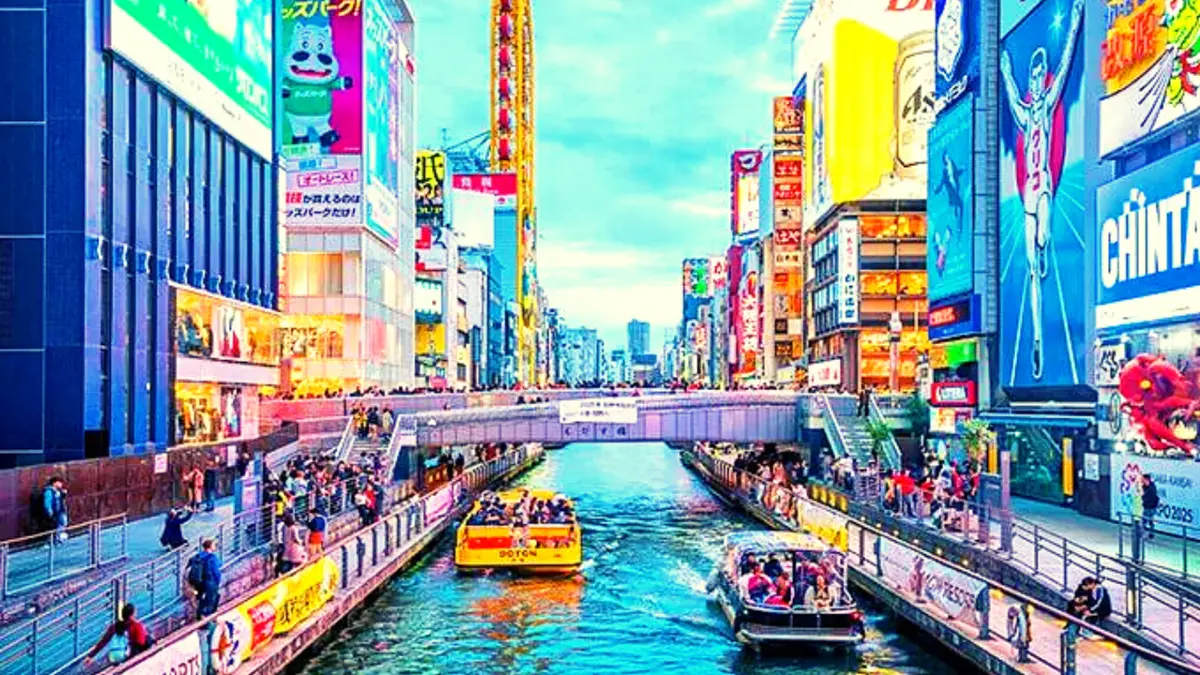
Osaka: Private or Group Hotspots & Hidden Gems Walking Tour
A three-hour walk that stretches to seven if you want it to, private or shared, with a takoyaki and a retro vending-machine drink included. The longer options use trains, which you pay for — usually under ¥1,000 a head.
Check Availability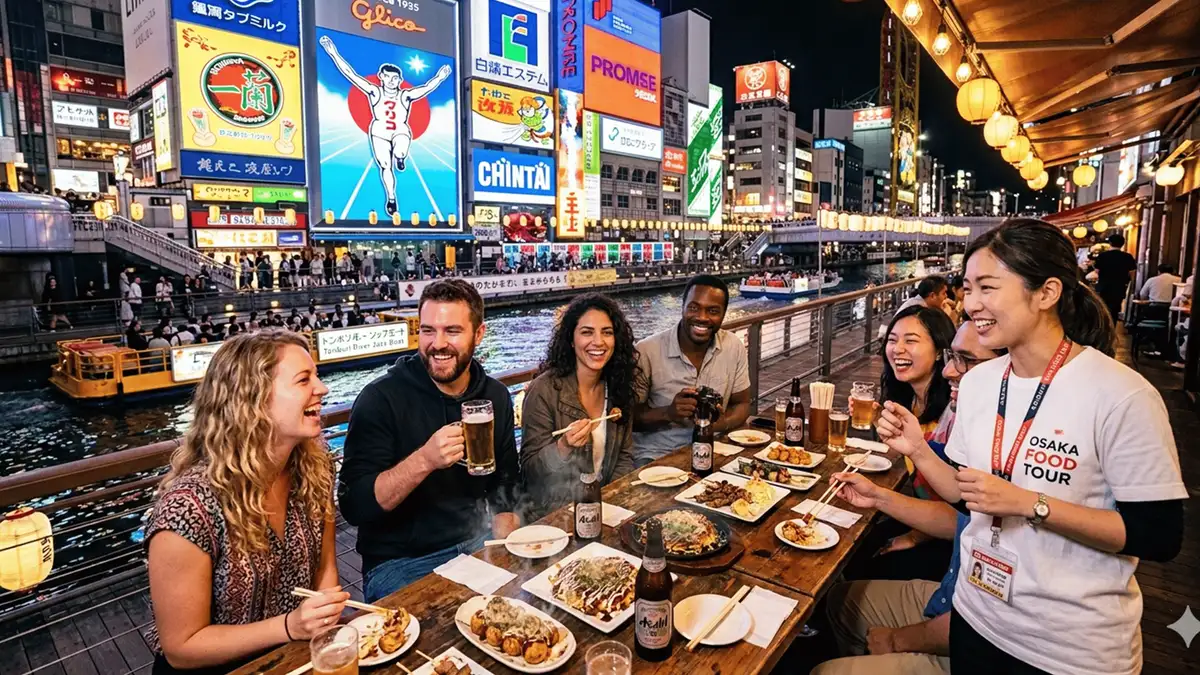 from $51.13
Osaka: Guided Food Tour with 12 Dishes and 2 drinks
Twelve dishes and two drinks in two and a half hours, taking in sake bars locals use and a street stall listed in the Michelin guide. Well rated, and among the cheaper options per dish in this group.
Check Availability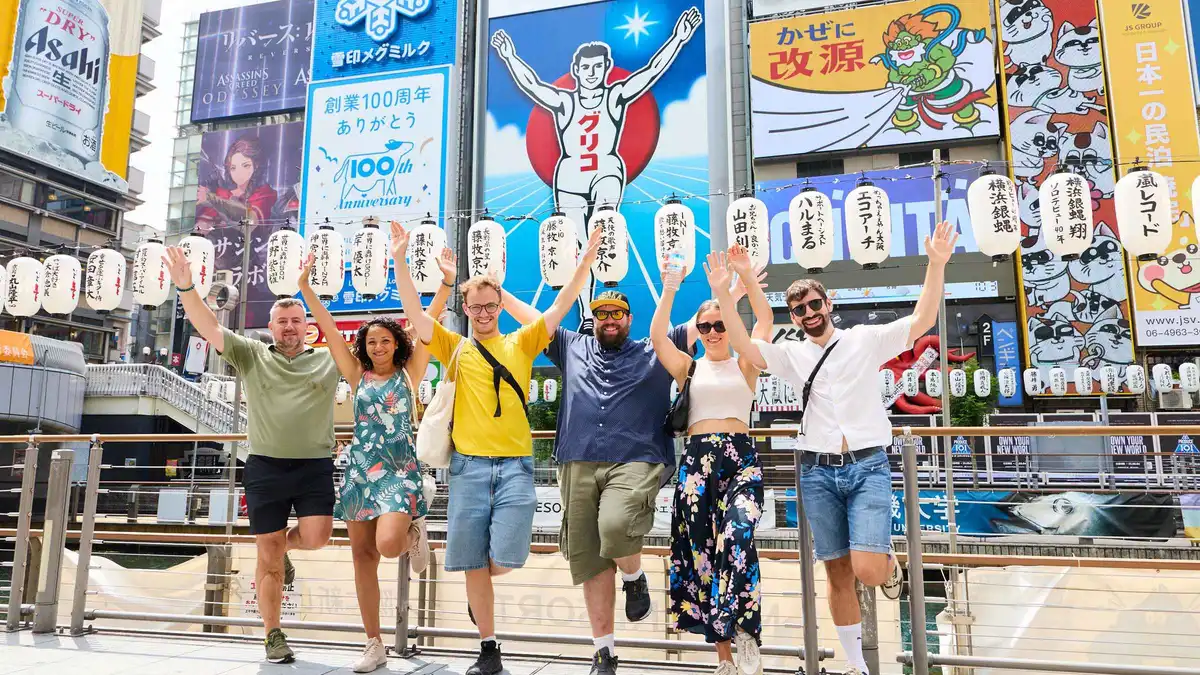 from $17.48
Osaka Walking Tour: Dotonbori, Kuromon Market & Street Food
Two and a half hours from Shinsaibashi through Hozen-ji, Kuromon Market and Den Den Town with a licensed guide and some food included. Cheap for a guided walk, but only 23 people have rated it so far.
Check Availability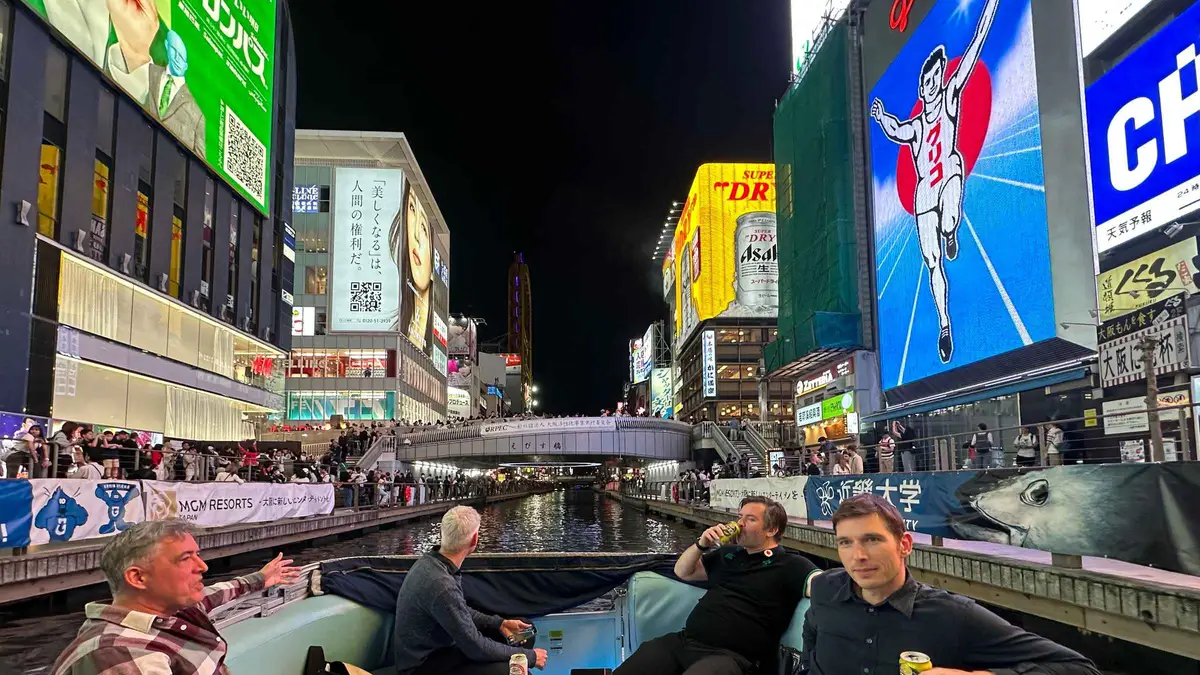 from $12.49
Osaka: Dotonbori River Cruise with Glico Sign & Neon Views
Twenty minutes on the water past the Glico sign, boarding at Minatomachi Pier rather than the Tombori River Walk, and you may bring your own drinks. The rival Tombori River Cruise is free with the Osaka Amazing Pass; this boat is not.
Check Availability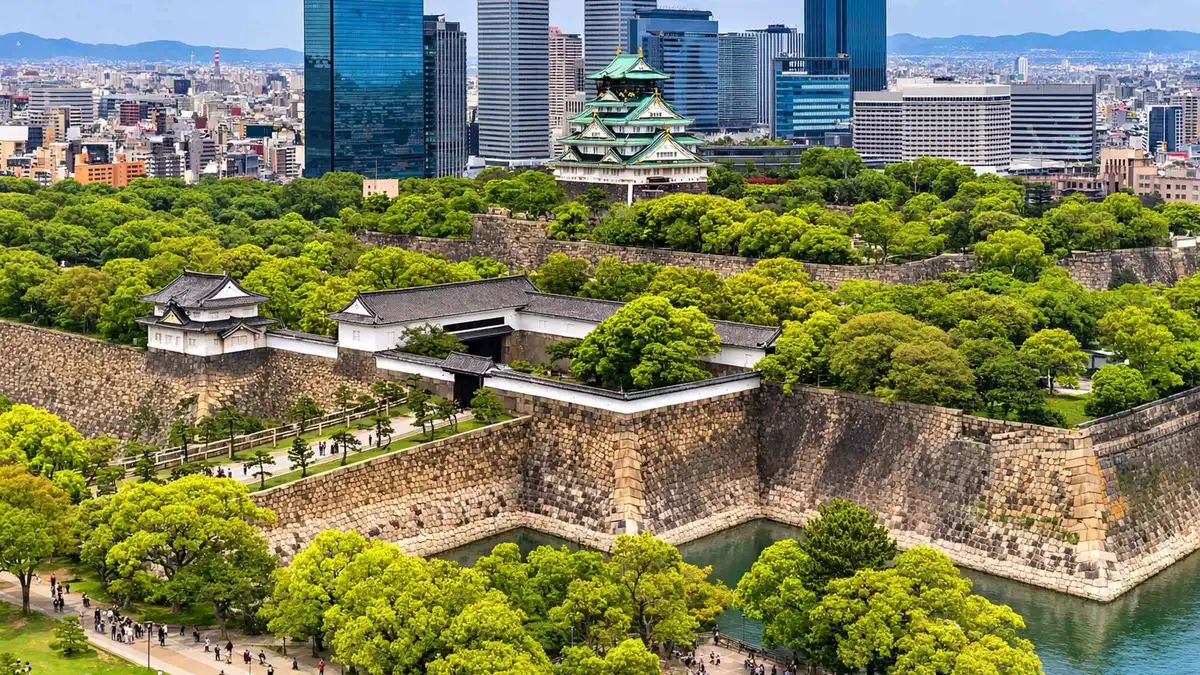 from $54.56
Osaka: Guided Walking Tour with a Native Expert – Top Sights
Four hours linking Osaka Castle, Tsutenkaku and Namba by metro, with the ¥1,200 keep admission included and the ¥430 of train fares not. A Japan Rail Pass buys you nothing here — the route runs on Osaka Metro.
Check Availability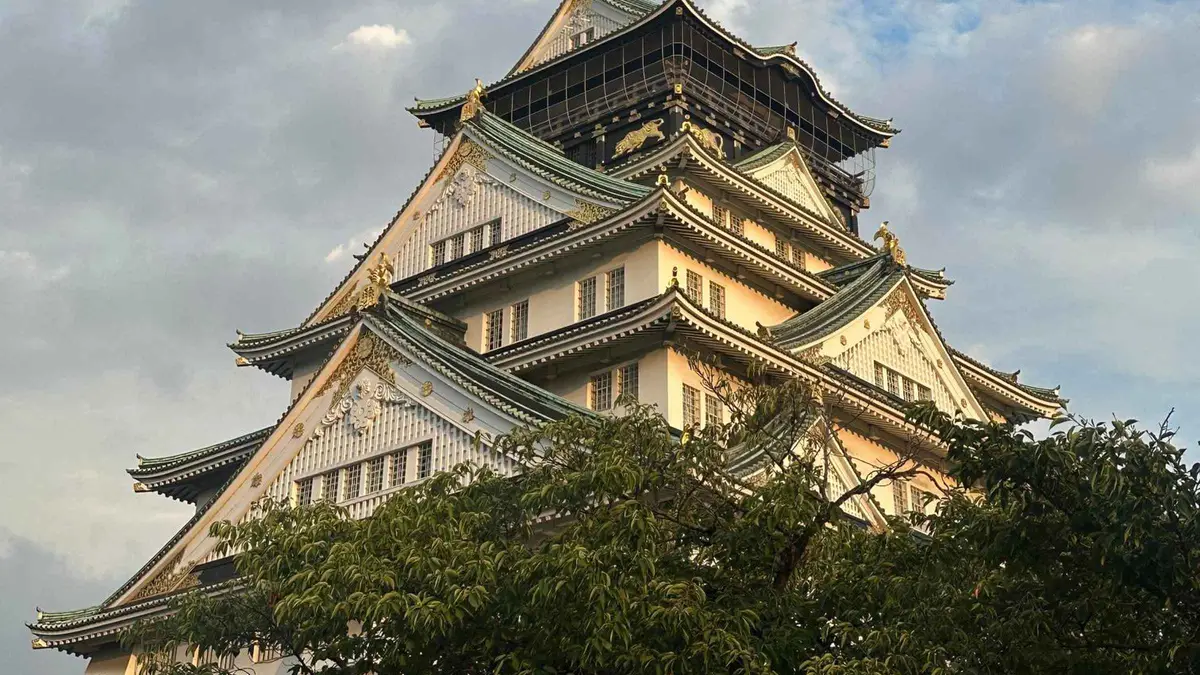 from $49.74
Osaka: Essential City Loop Tour with Local Guide
Five hours in a group of eight covering the castle, the Showa-era backstreets and the neon strip in one loop, with food bought stop by stop instead of a sit-down lunch. Only four people have rated it so far.
Check AvailabilityPrices, ratings and details are the platform's own. Dollar figures are the listed prices. The platform bills in your account's currency.
Five railways, two station names and one bus terminal
Namba's layout only makes sense once you know that the name covers several separate stations that were never designed to connect.
Nankai Namba is the big one and the reason the district exists: a nine-platform terminus at the top of a department store, and the Osaka end of the line to Kansai Airport and to Koyasan. Osaka Namba is a different station, shared by Kintetsu and Hanshin, and it faces east towards Nara. Osaka Metro's Namba sits underneath both on the Midosuji, Sennichimae and Yotsubashi lines, and JR Namba — the old Minatomachi — is a ten-minute walk west, inside the OCAT building. The tourism bureau's own directions to the canal name the Nankai, Kintetsu and three Metro lines in one breath, which is accurate and useless if you are dragging a case.
The rule that works: the Nankai gates are the centre of the district. Tourist Information NAMBA is on the first floor in front of the north exit and is open 09:00–20:00, staffed in English, Chinese and Korean, and the whole Osaka Convention & Tourism Bureau network answers one number, the Osaka Call Center on 06-6131-4550, daily 09:00–17:30. Walk north from those gates and you are at the canal in eight minutes without a map.
OCAT, the Osaka City Air Terminal, is the coach station. It is where the Kansai Airport limousine bus arrives, it has its own JR platform underneath, and it is the least pretty ten minutes in the district — an office block over a bus deck. Nobody lingers there and nobody should.
Where the lockers actually are
Nankai publishes no locker tariff, but it does publish counts, and Namba has more storage than anywhere in the city bar the JR terminal in the north: 124 small, 52 medium and 23 large on the basement level, plus 100 small, 36 medium, 20 large and 6 extra-large at the north exit. For a bag that will not fit any of them, n·e·s·t inside Nankai Namba takes ¥800 per item per day — the cheapest staffed counter in Osaka — for up to fourteen days, is open 09:00–21:00, has English-speaking staff and will forward a bag to a hotel for ¥2,500. Both figures come from the operators' own pages.
Kansai Airport to Namba: every option, priced
This is the single strongest practical argument for staying in the south, and the fares are published by the carriers themselves. Everything below comes from Nankai's and the bus operator's own pages; dollar glosses at ¥1,000 ≈ $6.27.
The Airport Express (空港急行) is the answer for most people. It runs from the airport station to the Namba terminal in about 44 minutes at the base fare, with no surcharge, no reservation and no seat guarantee. With luggage at rush hour it can be an uncomfortable 44 minutes, which is what the alternatives are for.
Rapi:t is the reserved limited express: the same journey in about 34 to 38 minutes for the base fare plus ¥700 in a regular seat or ¥910 in the Super Seat, child ¥350 or ¥560. Buying that limited-express ticket on board costs ¥300 more; buying it through Nankai's ticketless service costs ¥150 less. The better deal is the Kanku Toku-wari combined ticket, which bundles the fare and the express charge at $9.78 (¥1,560) in a regular seat or ¥1,740 in the Super Seat, child ¥780 or ¥980, sold at station counters and valid two consecutive days from first use.
The airport limousine bus to OCAT is ¥1,400 adult / ¥700 child and takes 50 minutes from Terminal 1, first-come with no reservation, with a 14-day open return at ¥2,500. It is worth the extra minutes only if you have more luggage than arms.
One thing to know before you buy a pass: the Osaka Amazing Pass is not valid to or from Kansai Airport, whichever version you hold. Neither is the Enjoy Eco Card. Airport travel is always a separate ticket.
| Route | Fare | Time | Reservation |
|---|---|---|---|
| Nankai Airport Express to Namba | Base fare only | about 44 minutes | None — walk on |
| Nankai Rapi:t, regular seat | Base fare + ¥700 (child ¥350) | about 34–38 minutes | Reserved seat; ¥150 off ticketless, ¥300 more on board |
| Nankai Rapi:t, Super Seat | Base fare + ¥910 (child ¥560) | about 34–38 minutes | Reserved seat |
| Kanku Toku-wari combined ticket | $9.78 (¥1,560); Super Seat ¥1,740 | as Rapi:t | Station counters; valid 2 consecutive days |
| Airport limousine bus to OCAT | ¥1,400 adult / ¥700 child | 50 minutes from Terminal 1 | First-come; 14-day open return ¥2,500 |
And the other airport
From Osaka Itami there is no direct train to Namba at all. The route is the monorail to Senri-Chuo at ¥340, then the Midosuji line the length of the city; or the limousine bus, whose fare the operator publishes only on a site that refuses our requests, so we do not print one. If you are flying domestically and staying in the south, budget an hour of city transit on top of the flight.
Namba Walk and the underground layer
Like the north, the south has a second high street below the pavement, and it keeps its own hours.
Namba Walk runs east from the Metro concourse under Sennichimae towards Nippombashi, and it is the fastest dry route between the station and the market. Its own site publishes hours by category — 10:00 to 21:00 for fashion, goods, cosmetics, services and food, and 10:00 to 22:00 for the restaurants and cafes — and one closed day a month, which for September 2026 is Wednesday 16 September. It also warns that individual shops open early or shorten hours without notice.
What is worth going down for: cheap lunch counters, the pharmacy chains, and — in July and August or in heavy rain — simply not being outside. Osaka's summer is the real argument for the underground layer; the walk from the Nankai gates to Kuromon is nine minutes above ground and about the same below, and one of the two is air-conditioned.
The passages also solve the district's worst transfer. Nankai Namba to Osaka Namba, the Kintetsu and Hanshin station, is a genuinely confusing walk at street level and a straightforward one underground, following the exit numbers on the ceiling rather than the shop names.
Eating in Minami, and the shop nobody here will name
This is the district Osaka's reputation rests on, which makes it the district where the naming rules matter most.
The tourism bureau's own konamon page puts it plainly: takoyaki and okonomiyaki are "cheap and delicious street food" and "a major part of Kansai food culture", abundant in the Minami area — this district. Kushikatsu, the skewered-and-fried dish with the no-double-dipping rule, is concentrated further south in Shinsekai. Takoyaki's own history is shorter than the marketing suggests: the bureau says shops "only began to pop up in the city in the 1950s", that the dish came from choboyaki and radioyaki by swapping dashi for water and adding octopus from Osaka Bay, and that the finish of sauce, mayonnaise, aonori and katsuobushi was "influenced by okonomiyaki after the war". It calls the every-household-owns-a-takoyaki-pan claim an urban legend.
And here is the part other guides skip. This site only names a restaurant when a citable list stands behind it — a MICHELIN selection, Slow Food, Gambero Rosso or the venue's own site. The MICHELIN Guide Kyoto Osaka 2026 Bib Gourmand selection for Osaka runs to 67 addresses, and not one of them is a takoyaki or okonomiyaki shop. So on the two dishes this district is famous for, we name nobody, and we say why rather than inventing a ranking. The genres MICHELIN does recognise nearby are kushiage, tonkatsu, udon, soba and ramen — Tonkatsu Minato at 2-9-26 Shimanochi in Chuo ward, a fifteen-minute walk north of the gates, is in the 2026 selection at the cheapest price band, and MICHELIN publishes neither its opening hours nor a closed day, as it does for none of the 67.
What to do with that: use a guided walk if you want somebody to make the choice for you — the twelve-dish evening tour and the market-and-canal morning walk both do exactly that — or use the queue rule, which is that in this district a line of Japanese office workers at 12:15 is a better signal than any list.
Nobody publishes an eating-while-walking rule
We searched for one: no Osaka district publishes a tabemaruki ban or a food-hygiene rule of its own — not this one, not the arcades, not the market, whose association site is behind a bot wall. What the city does publish, and what does cost money, is the street-smoking ban of 27 January 2025: city-wide, heated tobacco included, ¥1,000 fine. Eat standing at the stall you bought from and you are within every rule anyone has written down.
Shopping, and where the arcades actually go
Three covered streets meet in this district and they are not interchangeable — one is a shotengai, one is a fashion arcade and one is a food market.
Shinsaibashi-suji is the fashion one: about 580 metres of roofed arcade running north from the canal, with 380 years of history behind it and a footfall the bureau puts at roughly 60,000 on a weekday and 120,000 at the weekend. Worth knowing before you quote those numbers back at anyone: the association that actually runs the street publishes no length, no shop count and no founding year — every figure in circulation is the tourism bureau's. The arcade has its own page.
Ebisubashi-suji is the block between the arcade and the canal, and it is the one shopping street here with a body behind it: the association's own site says the street formed in the Edo period and that the modern union was founded in 1913. Its certificate has expired, which tells you something about how much attention the district pays to its own web presence.
Kuromon Ichiba is food: about 580 metres, roughly 150 stalls, a market since merchants sold Sakai and Kishu fish near Enmyoji temple in 1822–1823, burnt in the Great Namba Fire of 1912 and again in the air raids, and rebuilt both times. Its hours are the great unpublished fact of Osaka — the bureau says only "varies by location", the market's own site is behind a Cloudflare challenge that refused us, and any guide printing "9:00 to 18:00, closed Sundays" has guessed. The market page covers what actually works.
Den Den Town, south-east towards Nippombashi, is the electronics and anime quarter, and Namba Parks is the terraced shopping centre built onto the old baseball ground directly above the Nankai tracks at 2-10-70 Namba-naka. Its own site publishes no house opening hours at all, only per-shop pages, so we print none.
Getting out of Namba, and what a day of it costs
Namba is the southern anchor of the Midosuji line, so most of the city is one ride away. The fares below are Osaka Metro's own bands and the two passes' own published prices.
Metro fares run ¥190 up to 3 km, ¥240 to 7 km, ¥290 to 13 km, ¥340 to 19 km and ¥390 beyond, and the operator publishes the station-by-station zone table only as a PDF image, so treat ¥190–¥240 as the working figure for anything inside the centre. The Enjoy Eco Card at ¥820 on a weekday, ¥620 at weekends and holidays, covers all Metro lines and city buses for a calendar day and pays for itself in three or four rides.
From the Namba gates: the castle is a change at Hommachi or Tanimachi 4-chome, the bay and the aquarium are the Chuo line via Hommachi, Tennoji and the tower district are four stops south on the Midosuji, and Umeda is eight minutes north on the same line. Kyoto is the awkward one — the fast private route leaves from the north, so a Kyoto day trip from a Namba hotel starts with a Metro ride.
One local quirk worth having: a "day" on the Osaka Amazing Pass runs 03:00 to 02:59, not 24 hours. In a district where dinner routinely finishes after midnight, that matters — activate a one-day pass at 22:00 and you have five hours of it, not twenty-four.
| From Namba to | Line | Ride | What is at the other end |
|---|---|---|---|
| Umeda | Midosuji, northbound | about 8 minutes | The five terminals, the arcades under the station, the roof views |
| Tennoji | Midosuji, southbound | about 8 minutes | The park, the zoo, the tall building and the cheap beds |
| Osakako, for the bay | Sennichimae then Chuo at Awaza | about 15 minutes | The aquarium, the wheel and the ferry across to the studios |
| Osaka Castle | Sennichimae then Chuo, or Midosuji then Tanimachi | about 15 minutes | The keep, the park and the history museum |
| Kansai Airport | Nankai, from the terminal above you | about 44 minutes | Airport Express at base fare — the reason to stay here |
Namba map: the gates, and everything a ten-minute walk from them
Stations in blue, the six places with their own pages in copper. Pin positions are ours, placed from the operators' and venues' published addresses.
Nothing on this map is more than about a kilometre from the Nankai gates, and the underground passages connect most of it.
Next stop from Namba
Walking times are our estimates from the published addresses; ride times are the operators' own line maps.
Dotonbori
The canal cut in 1612, the bridges and the signage. Free, open at every hour, and worth doing after dark rather than at noon.
8 minutes north on footShinsekai
The 1903 exposition district: kushikatsu, the tower and about fifty places to eat along 130 metres of Janjan Yokocho.
Two Metro stops south, or 20 minutes on footTennoji
The park, the zoo, the temple and the city's cheapest beds, all around one interchange.
About 8 minutes on the Midosuji lineSleeping in the south
No nightly rate is printed here: we did not price these areas on a fixed date, and an invented band is worse than none. What follows is what each pocket buys you and what the prefecture adds — Osaka's lodging tax was rebanded on 1 September 2025 and is charged per person per night.
Namba and Nippombashi
- Where it sits
- On top of the Nankai terminal; the canal is eight minutes north
- Suits
- First visits, late dinners, and arriving from Kansai Airport at base fare
The most convenient base in Osaka for a trip that is about Osaka. Rooms nearest the canal are the loudest in the city on a Friday; a block east towards the market is quieter for the same money.
See stays in NambaShinsaibashi and Nishi-Shinsaibashi
- Where it sits
- 10 to 15 minutes north of the gates, on the Midosuji line
- Suits
- Shopping, bars, and a shorter walk to the northern half of the centre
The arcade end of the district, with Amerikamura on its western side. Better connected northwards than Namba itself, and further from the airport train.
See stays in ShinsaibashiNamba Naka and the OCAT side
- Where it sits
- 5 to 12 minutes west of the terminal, around the coach station
- Suits
- Early coaches, late arrivals, travellers with heavy luggage
Plain business hotels within sight of the bus deck. Nothing to look at, but the airport coach stops at the door and the Nankai gates are a covered walk away.
See stays in west NambaThe prefecture's lodging tax is nothing under ¥5,000 per person per night, then ¥200, ¥400 or ¥500 as the rate crosses ¥5,000, ¥15,000 and ¥20,000 — bands in force since 1 September 2025, and most sites still print the superseded ¥100 / ¥200 / ¥300. We may earn a commission if you book through these links, at no extra cost to you.
Namba questions
What is Namba in Osaka famous for?
Being the southern centre — Minami — and the district where the eating, the arcades and the airport terminal sit on top of each other. It is famous by association rather than for a monument: the canal, the covered shopping streets and the food market are all within ten minutes of its gates, and the table above prices and times each one.
Is Namba a good place to stay in Osaka?
It is the best base for a trip that is about Osaka itself: Nankai's Airport Express reaches it from Kansai in about 44 minutes at base fare, and you can walk home from dinner. If your week is really about Kyoto, Kobe and Himeji, the northern district puts you on the fast lines instead. The area comparison sets all five side by side.
How do you get from Kansai Airport to Namba?
Nankai's Airport Express, about 44 minutes at base fare with no surcharge and no reservation. Rapi:t does it in 34 to 38 minutes for ¥700 more in a regular seat, or $9.78 (¥1,560) all-in on the Kanku Toku-wari ticket. The limousine bus to OCAT is ¥1,400 and takes 50 minutes. No pass covers airport travel — the full comparison is here.
How many stations are called Namba?
Four, run by five companies: Nankai Namba, Osaka Namba for Kintetsu and Hanshin, Osaka Metro's Namba on three lines, and JR Namba inside the OCAT building ten minutes west. They are separate stations with separate gates, and the underground passages between them are easier than the street.
What are the opening hours of Namba Walk?
10:00 to 21:00 for shops and 10:00 to 22:00 for the restaurants and cafes, with one closed day a month — Wednesday 16 September 2026 is the September date. Individual units open early or close early without notice, which the operator says itself.
Where should you eat in Namba?
Along the canal and in the lanes behind it after 18:00, and at the market in the late morning. This site names a restaurant only when a citable list stands behind it, and MICHELIN's 2026 Bib Gourmand selection for Osaka contains no takoyaki or okonomiyaki venue at all — so for the two dishes the district is known for we name nobody. A guided evening walk with twelve dishes is the shortcut past that problem.
Is Namba safe at night?
No authority publishes a district-level safety ranking for Osaka, so anyone telling you which areas to avoid is giving you an opinion rather than a figure. What is published is the city-wide street-smoking fine of ¥1,000, in force since 27 January 2025, and the emergency numbers: 110 for police, 119 for fire and ambulance, and the 24-hour Japan Visitor Hotline on 050-3816-2787.
Namba on film: the underground, the evening and the walk north
Three walk-throughs we checked ourselves — each id verified against YouTube's own record and its thumbnail, so none of these is a dead player. They load only when you press play.
The Namba Walk Underground Shopping Center in Osaka Japan
The underground arcade end to end, which is the layer no map explains well.
Video: Immerse In WalkingEvening Walk in Namba Osaka, Japan
Street level after dark, at real pace and with the real crowd.
Video: Immerse In WalkingNamba to Shinsaibashi: Exploring Osaka's Most Iconic Districts | Walking Tour | 4K HDR
The ten-minute walk north from the gates to the arcade, filmed in one take.
Video: THE JAPAN WALKVideos load from YouTube only when you press play.
Prices, hours and terms are set by the venue or operator and confirmed at checkout.
We may earn a commission if you book through one of our links, at no extra cost to you. Full affiliate disclosure